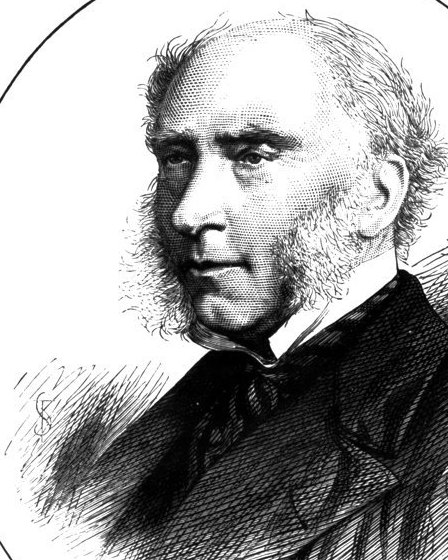
John Phillips
Geologist, keeper of the Yorkshire Museum, and later professor of geology at Oxford
In their own words
“From childhood my attention has been fixed on the great County in which most of the labours and enjoyments of my life have been experienced.”
John Phillips, The Rivers, Mountains, and Sea-Coast of Yorkshire (London: John Murray, 1853), Preface. See the page
Who they were
Phillips was born at Marden, in Wiltshire, on Christmas Day 1800.
From T. G. B., "Phillips, John (1800-1874)", Dictionary of National Biography, vol. 45 (1896): “was born at Marden in Wiltshire on 25 Dec. 1800” See the page
He lost both his parents as a small boy. His uncle, the geologist William Smith, took him in and taught him geology.
From T. G. B., "Phillips, John (1800-1874)", Dictionary of National Biography, vol. 45 (1896): “his mother was a sister of William Smith ... When about seven years old he lost his father, and about a year later his mother died. The uncle then took charge of the boy, and at once initiated him in geology.” See the page
He worked beside his uncle, in the field and in the office, until the spring of 1824.
From T. G. B., "Phillips, John (1800-1874)", Dictionary of National Biography, vol. 45 (1896): “The joint labour in the field and in the office was continued till the spring of 1824” See the page
He then set out the fossils in the museum at York, and a year later he became its keeper.
From T. G. B., "Phillips, John (1800-1874)", Dictionary of National Biography, vol. 45 (1896): “John Phillips was entrusted with the arrangement of the fossils in the museum, and next year was appointed its keeper.” See the page
The British Association met for the first time at York in 1831. Phillips did most of the work of setting it up.
From T. G. B., "Phillips, John (1800-1874)", Dictionary of National Biography, vol. 45 (1896): “In 1831 the British Association held its first meeting at York, and Phillips took the leading part in the work of organisation.” See the page
He went to Oxford in 1853 as deputy to William Buckland. He became reader in geology in 1856, and later professor.
From T. G. B., "Phillips, John (1800-1874)", Dictionary of National Biography, vol. 45 (1896): “Here he remained till 1853, when he succeeded Hugh Strickland ... as deputy at Oxford for Professor William Buckland ... On the death of the latter in 1856, he became ‘reader in geology,’ and at a later date was constituted professor.” See the page
People liked to hear him speak, and he was good at running things.
From T. G. B., "Phillips, John (1800-1874)", Dictionary of National Biography, vol. 45 (1896): “Phillips was an attractive speaker and lecturer, an excellent organiser” See the page
He never married. He died on 24 April 1874, after a fall on a staircase at All Souls' College, Oxford.
From T. G. B., "Phillips, John (1800-1874)", Dictionary of National Biography, vol. 45 (1896): “he died on 24 April 1874, from the result of a fall on a staircase at All Souls' College. He was unmarried.” See the page
In Craven
He pictured Ingleborough from what he had read and heard long before he saw it.
From John Phillips, The Rivers, Mountains, and Sea-Coast of Yorkshire (London: John Murray, 1853), Preface: “Long before my eyes rested on the mountains of the north of England, the mighty form of Ingleborough was engraved in my imagination by many a vivid description” See the page
In 1821 he walked through Skipton and Settle. He then traced the Craven Fault from Settle to Kirkby Lonsdale.
From John Phillips, Illustrations of the Geology of Yorkshire, Part II: The Mountain Limestone District (London: John Murray, 1836), Introduction: “In 1821, I made an active pedestrian tour of four months in the North of England ... Colne, Skipton, and Settle. From Settle to Kirby Lonsdale, the line of the great Craven fault was attentively surveyed” See the page
He came back in 1827 to study the Craven Fault again. He then wrote a paper on it for the Geological Society.
From John Phillips, Illustrations of the Geology of Yorkshire, Part II: The Mountain Limestone District (London: John Murray, 1836), Introduction: “a leisurely review of the Craven fault and its attendant phenomena enabled me to draw up for the Geological Society a memoir on that district” See the page
Walkers on a geological tour in 1856 took his book on the geology of Yorkshire as their guide.
From The Settle Chronicle and North Ribblesdale Advertiser, 1856 volume, from the Museum of North Craven Life's scans: “in" Phillips' Geology of Yorkshire," our guide throughout” See the page
In 1858 he took the train into Craven with members of the British Association. He was bound for Malham and Gordale, with his hammer.
From The Settle Chronicle and North Ribblesdale Advertiser, 1858 volume, from the Museum of North Craven Life's scans: “Professor Phillips, with his geological hammer and carpet bag, intent upon Malham and Gordale” See the page
20 quotes on 17 places
A bigger dot means more quotes. Tap a dot to open the place.
What they wrote
-
Gaping Gill, and 1 more
1853
“When Mr. Birkbeck descended the fearful gulf of Gaping Gill, he found at about 80 feet a rush of water from the side”
John Phillips, geologist. See the page
Source
The Rivers, Mountains, and Sea-coast of Yorkshire (London: J. Murray, 1853), page 34.
-
Ingleborough Cave, and 1 more
1853
“The time consumed in the formation of even one stalagmitical boss is not easily determined.”
John Phillips, geologist. See the page
Source
The Rivers, Mountains, and Sea-coast of Yorkshire (London: J. Murray, 1853), page 34.
-
Yordas Cave, and 1 more
1853
“Its narrow opening in the limestone rock is closed by a door, — a precaution not to be censured, by those who know what wanton destruction has been caused to many miracles of nature”
John Phillips, geologist. See the page
Source
John Phillips, The Rivers, Mountains, and Sea-Coast of Yorkshire (London, 1853), page 25.
-
1853
“masses of the slaty rocks have been drifted by some force of water to the southwest, south, and south-east, not merely or even mainly by the valleys, but over the high ground — so as to rest on the limestone hills above Ingleborough House and Austwick”
John Phillips, geologist. See the page
Source
John Phillips, The Rivers, Mountains, and Sea-Coast of Yorkshire (London, 1853).
-
1853
“the Wharfe emerges into that sweet and picturesque combination of cliff, meadow, forest, and monastic ruins, which has rendered Bolton Abbey dear to the painter of nature”
John Phillips, geologist, Professor of Geology at Oxford. See the page
Source
John Phillips, The Rivers, Mountains, and Sea-Coast of Yorkshire (London, 1853), page 80.
-
1853
“The Hambleton hills, the Wolds, no less than Giggleswick Scar, were cliffs against a wide sea.”
John Phillips, geologist. See the page
Source
John Phillips, The Rivers, Mountains, and Sea-Coast of Yorkshire (London, 1853), page 11.
-
1853
“This is Gordale, which is said to have first received its water in 1730, after a violent thunderstorm.”
John Phillips, geologist. See the page
Source
John Phillips, The Rivers, Mountains, and Sea-Coast of Yorkshire (London, 1853), page 93.
-
1853
“Ingleborough has attractions for the geologist of no ordinary kind.”
John Phillips, geologist. See the page
Source
The Rivers, Mountains, and Sea-coast of Yorkshire (London: J. Murray, 1853), page 35.
-
1853
“On the moorland above Starbottom and Kettlewell, 80 RIVERS. a waterspout burst in 1686, causing enormous devastation in these villages.”
John Phillips, geologist, Professor of Geology at Oxford. See the page
Source and note
John Phillips, The Rivers, Mountains, and Sea-Coast of Yorkshire (London, 1853), page 80.
The page break falls inside the sentence; '80 RIVERS.' is the scan's page heading.
-
1853
“Airedale has an origin quite unlike that of any other great Yorkshire dale, for its river springs at once, a full stream, from under a huge cliff of limestone called Malham Cove, 285 feet in height.”
John Phillips, geologist. See the page
Source
John Phillips, The Rivers, Mountains, and Sea-Coast of Yorkshire (London, 1853), page 92.
-
1853
“Malham Water — a beautiful lake, strangely placed on the high ground ... from which a rill proceeds, but is soon absorbed by the jointed rocks.”
John Phillips, geologist. See the page
Source
John Phillips, The Rivers, Mountains, and Sea-Coast of Yorkshire (London, 1853), page 92.
-
1853
“from which it never escapes till it encounters the gritstone hills of Barden Fell and Symon's Seat.”
John Phillips, geologist. See the page
Source and note
John Phillips, The Rivers, Mountains, and Sea-Coast of Yorkshire (London, 1853), page 79.
Phillips means the limestone that the Wharfe runs over above Burnsall.
-
1853
“rocks contracting below to form narrow channels, of which the ' Strid/ immortalized by Wordsworth, is most remarkable, for the rapid and powerful river.”
John Phillips, geologist, Professor of Geology at Oxford. See the page
Source and note
John Phillips, The Rivers, Mountains, and Sea-Coast of Yorkshire (London, 1853), page 80.
The scan reads 'Strid/' for 'Strid,'.
-
1853
“not far below it the pretty waterfall of Thornton Force.”
John Phillips, geologist. See the page
Source and note
John Phillips, The Rivers, Mountains, and Sea-Coast of Yorkshire (London, 1853), page 25.
'It' is the Cavern of Yordas.
-
1853
“Yordas Cave , in the parish of Thornton in Lonsdale, is at the foot of the upper slopes of Graygarth or Gragreth”
John Phillips, geologist. See the page
Source
John Phillips, The Rivers, Mountains, and Sea-Coast of Yorkshire (London, 1853), page 25.
-
1853
“But Weathercote, by far the most magnificent cavern, has the uncommon ornament of a violent cascade”
John Phillips, geologist. See the page
Source
The Rivers, Mountains, and Sea-coast of Yorkshire (London: J. Murray, 1853), page 29.
-
1853
“the mural precipices which gird the bases of Whernside, Ingleborough and Penyghent, formed bold margins to similar branches of the sea”
John Phillips, geologist. See the page
Source
John Phillips, The Rivers, Mountains, and Sea-Coast of Yorkshire (London, 1853).