UK · England · North Yorkshire · Craven · Wharfedale and Littondale
Kettlewell

With children
In 1686 a terrible storm burst over the moors. Thunder, hail and rain rushed down from the hills and out of the caves. The water tore up the river banks at Kettlewell and Starbotton.
This story comes from a petition for a royal brief, in 1686, Harry Speight, writing in 1892, and John Phillips, writing in 1853.
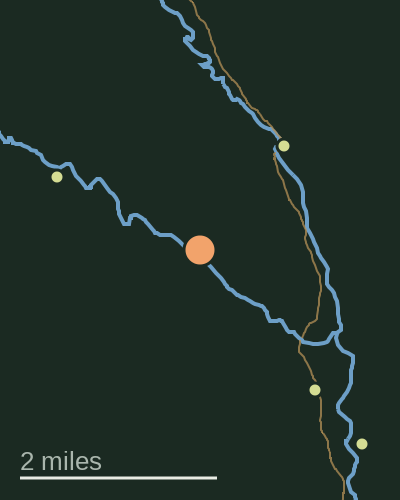
When you get there Find the river. Harry Speight said local people called it the gurt beck, which means the great stream.
What the writers say
A petition of 1686 describes the storm that tore through Kettlewell and Starbotton, and Phillips still wrote about it in 1853. Speight liked the village because it was so far from a railway. Howson noticed the old font, with a hole that let the water drain into holy ground.
-
1686 · July 1686
“there happened an earthquake and a violent and dreadful Tempest of Thunder, haile, and raine, which descended soe violently from the Mountaines and out of ye cavernes, that it immediately overrun and did teare up the bancks of the rivers running through ye townes of Kettlewell and Starbotton”
A petition for a royal brief, asking all England for money for the people of Kettlewell and Starbotton. See the page
Source and note
Harry Speight, The Craven and North-West Yorkshire Highlands (London: Elliot Stock, 1892), page 334.
The storm was on 8 June 1686. The petition puts the total loss at £3017 11s. 8d.
-
1850
“The font is curious, having an aperture in the bottom, and another in the floor, through which the water might sink into consecrated ground.”
William Howson, Settle guidebook writer. See the page
Source
William Howson, An Illustrated Guide to the Curiosities of Craven (London and Settle, 1850), page 31.
-
1853
“On the moorland above Starbottom and Kettlewell, 80 RIVERS. a waterspout burst in 1686, causing enormous devastation in these villages.”
John Phillips, geologist, Professor of Geology at Oxford. See the page
Source and note
John Phillips, The Rivers, Mountains, and Sea-Coast of Yorkshire (London, 1853), page 80.
The page break falls inside the sentence; '80 RIVERS.' is the scan's page heading.
-
1855
“in three large· Booths which were erected on the green in front of the vicarage, where the scholars and a few friends of education, numbering together more than 260 persons, partook of tea, currant cakes and many other good things”
Settle Chronicle, the monthly Settle paper. See the page
Source and note
The Settle Chronicle and North Ribblesdale Advertiser, 1855 volume. Scans held by the Museum of North Craven Life, published by the North Craven Building Preservation Trust (CC BY-NC-SA 4.0), page 32.
The anniversary of Kettlewell Church Sunday School.
-
1863 · 5 March 1863
“We would leave it for a few days, or for a week, till the air got good again, and then we would go back again. ... when we were a week; it was at hay time, and we were at hay, and we did not go for a week.”
Thomas Wiseman, manager of the Appletreewick lead mine, who had worked as a miner at Kettlewell. See the page
Source and note
Minutes of evidence taken before the Commissioners appointed to inquire into the condition of mines in Great Britain, evidence taken at Grassington, in Reports from Commissioners, 1864, vol. 24 (London, 1864), page 432.
He was speaking of the small trial mines at Kettlewell. There the miners knew the air was bad when their candles would not burn.
-
1892
“The natives call the Wharfe the gurt (great) beck”
Harry Speight, Bingley writer who walked the dales. See the page
Source
Harry Speight, The Craven and North-West Yorkshire Highlands (London: Elliot Stock, 1892), page 333.
-
1892
“Kettlewell is a delightful place to stay at, and its remoteness from railway metals is certainly not the least of its charms.”
Harry Speight, Bingley writer who walked the dales. See the page
Source and note
Harry Speight, The Craven and North-West Yorkshire Highlands (London: Elliot Stock, 1892), page 333.
Speight opens the chapter: Kettlewell is fifteen miles from the nearest railway platform.
Visit
From the guide. Nobody pays to be here.
The Racehorses, Kettlewell
The Racehorses is a hotel and bar by the bridge in Kettlewell.
“Kettlewell, Marshall's.”
William Howson, 1850. See the page
The Blue Bell, Kettlewell
The Blue Bell is an inn with six rooms in the middle of Kettlewell.
“The excellent Race Horses hotel was then kept by John Marshall, and the Blue Bell by James Pickard”
Harry Speight, 1900. See the page