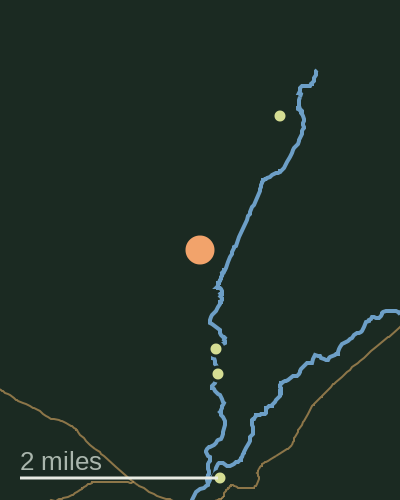
UK · England · North Yorkshire · Craven · In Thornton in Lonsdale
Thornton Force

With children
Thornton Force falls 63 feet over the edge of the cliff. Harry Speight said you could walk behind it, because the water arches out over the rock face.
This story comes from Harry Speight, writing in 1892.
When you get there Look for the gap between the falling water and the rock.
What the writers say
Hutton saw part of the river fall from the top and part burst from a passage in the rock. Howson gives the drop as sixty feet and Speight as 63. Speight says you could walk behind the fall. In 1907 the Leeds Mercury called it the finest waterfall in the district.
-
1779 · tour of about 1779, printed 1789
“If the archetype was not in being, it might be thought the subterranean stream was added to the picture, by the ingenuity of the artist, in order to give a finishing stroke to the beauty of the scene.”
Rev. J. Hutton, clergyman, touring the caves. See the page
Source
A Tour to the Caves in the West-Riding of Yorkshire, printed in Thomas West, A Guide to the Lakes, 4th edition (London and Kendal, 1789).
-
1779 · tour of about 1779, printed 1789
“Part of the river tumbled with impetuosity from the top of a stratum of huge rocks, perpendicularly about 20 yards”
Rev. J. Hutton, clergyman, touring the caves. See the page
Source
A Tour to the Caves in the West-Riding of Yorkshire, printed in Thomas West, A Guide to the Lakes, 4th edition (London and Kendal, 1789).
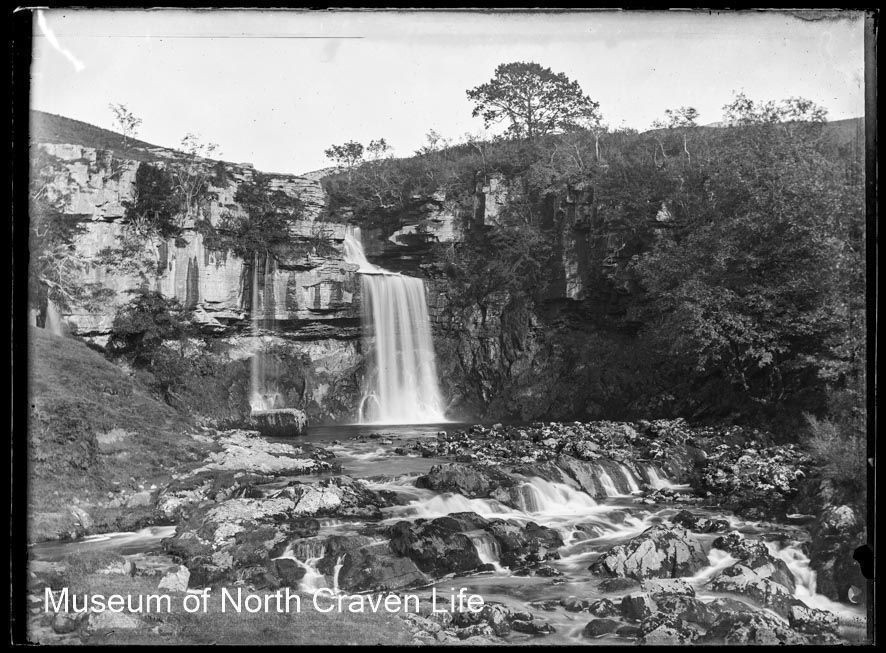
Thornton Force, Horner Photographic Studio, about 1875 to about 1925, Victorian. The Horner Photographic Collection, Museum of North Craven Life (The Folly), Settle. CC BY 4.0. See the work -
1850
“Here the stream falls over a precipice to the depth of sixty feet, into a deep black basin”
William Howson, Settle guidebook writer. See the page
Source and note
William Howson, An Illustrated Guide to the Curiosities of Craven (London and Settle, 1850), page 102.
Howson calls it Thornton Foss.
-
1853
“not far below it the pretty waterfall of Thornton Force.”
John Phillips, geologist. See the page
Source and note
John Phillips, The Rivers, Mountains, and Sea-Coast of Yorkshire (London, 1853), page 25.
'It' is the Cavern of Yordas.
-
1892
“the cascade may be passed from behind as it arches over the face of the cliff.”
Harry Speight, Bingley writer on the Yorkshire dales. See the page
Source
Harry Speight, The Craven and North-West Yorkshire Highlands (London: Elliot Stock, 1892), page 229.
-
1892
“The perpendicular height of the Fall is 63 feet, but the rocks on the left are fully 30 feet higher.”
Harry Speight, Bingley writer on the Yorkshire dales. See the page
Source
Harry Speight, The Craven and North-West Yorkshire Highlands (London: Elliot Stock, 1892), page 229.
-
1907 · 17 May 1907
“Soon Thornton Force is seen, the finest waterfall in the district, descending over a level limestone bed some thirty or forty feet”
Leeds Mercury, a newspaper, in the British Newspaper Archive's free search extract. See the page
Source
Leeds Mercury, 17 May 1907, page 7; the words come from the free extract the British Newspaper Archive's search shows, page 7.