UK · England · North Yorkshire · Craven · Ingleborough, Ingleton and Clapham
Chapel-le-Dale

What the writers say
Housman looks down on a narrow green valley between bare hills. Hutton found Hurtle Pot one of the most dismal places he had seen, Southey describes sheep sheltering in the chapel porch, and Speight calls the dale one of the wonders of Yorkshire.
-
1779 · tour of about 1779, printed 1789
“it was indeed one of the most dismal prospects we had yet been presented with.”
Rev. J. Hutton, clergyman, touring the caves. See the page
Source and note
A Tour to the Caves in the West-Riding of Yorkshire, printed in Thomas West, A Guide to the Lakes, 4th edition (London and Kendal, 1789), page 255.
Hutton is at Hurtle Pot, about eighty yards above the chapel.
-
1800 · 1800 (this copy printed 1808)
“The long naked vale of Chapel le Dale lies at our feet, like a green strip of silk connecting two webs of the coarsest cloth.”
John Housman, guidebook writer. See the page
Source
A Descriptive Tour, and Guide to the Lakes, Caves, Mountains, and other Natural Curiosities (Carlisle: F. Jollie, 1808 edition), page 56.
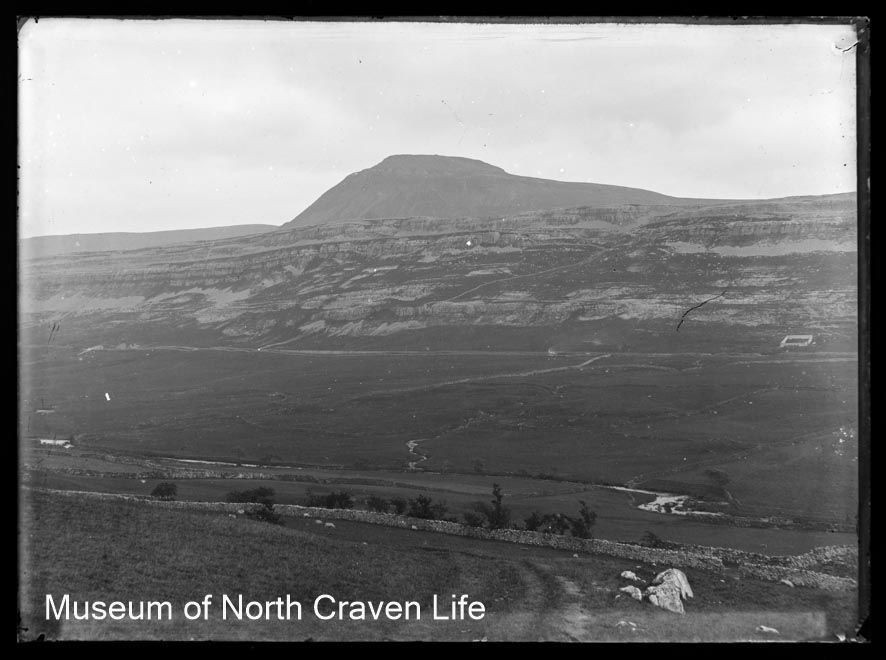
Ingleborough from Chapel-le-Dale, Horner Photographic Studio, 1890 to 1920, Victorian. The Horner Photographic Collection, Museum of North Craven Life (The Folly), Settle. CC BY 4.0. See the work -
1834
“The sheep came over the wall when they listed, and sometimes took shelter in the porch from the storm.”
Robert Southey, poet, in his novel The Doctor. See the page
Source
The Doctor, &c., vol. I (London: Longman, 1834), page 58.
-
1857
“The living of Chapel-le-Dale is, I believe, just sufficient to keep a poor curate from absolute starvation”
Jerry Daffelem, in the Settle Chronicle, touring the caves round Ingleborough. See the page
Source
The Settle Chronicle and North Ribblesdale Advertiser, 1857 volume. Scans held by the Museum of North Craven Life, published by the North Craven Building Preservation Trust (CC BY-NC-SA 4.0), page 49.
-
1873 · printed 1873
“There's been a good many deaths—what with accidents, low fevers, small-pox, and so on. I've buried three o' my own. I'm arter a sort the undertaker o' the place. You passed the little church down at Chapel-a-dale, near the head of the valley. "Well, in the three years I've toted over a hundred of us down the hill to the little churchyard lying round the church.”
Mr Pollen, as Archibald Forbes calls him, a former navvy who kept a shop at Batty Wife Hole. See the page
Source and note
Archibald Forbes, Glimpses through the Cannon-Smoke (Boston: J. R. Osgood, 1881), 'An Evening Party among the Navvies', page 18.
He said the parish clerk looked in his books and counted a hundred and ten. They had to add a piece on to the churchyard because it was full.
-
1877 · 25 August 1877
“killed 71 brace of grouse on Scales’ moor”
Ripon Gazette, a newspaper, in the British Newspaper Archive's free search extract. See the page
Source and note
Ripon Gazette, 25 August 1877, page 4; the words come from the free extract the British Newspaper Archive's search shows, page 4.
On 12 August 1877.
-
1892
“This little dale is, indeed, one of the wonders of Yorkshire.”
Harry Speight, Craven historian and walker. See the page
Source
The Craven and North-West Yorkshire Highlands (London: Elliot Stock, 1892), page 243.

Visit
From the guide. Nobody pays to be here.
White Scar Cave
Guides take visitors through White Scar Cave, the longest show cave in Britain.


