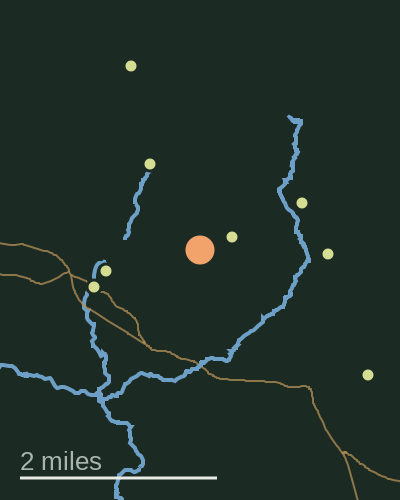
UK · England · North Yorkshire · Craven · In Clapham
Ingleborough Cave

With children
In 1837 a gardener called Josiah Harrison broke through a wall of stalagmite inside this cave. Until then, nobody knew about the passages beyond it. Inside the cave is a stalagmite called the Jockey Cap. William Boyd Dawkins measured it in 1873, and it had grown since 1839.
This story comes from John Phillips, writing in 1853, William Boyd Dawkins, writing in 1874, and Harry Speight, writing in 1892.
When you get there If you go on the cave tour, look for the Jockey Cap. It grows from drips of water.
What the writers say
Josiah Harrison broke through a wall of stalagmite in 1837 and opened the cave beyond. Phillips, Dawkins and Speight each studied one stalagmite, the Jockey Cap. Phillips says its age is hard to work out, Dawkins measured it growing between 1839 and 1873, and Speight puts it at 305 years.
-
1853
“The time consumed in the formation of even one stalagmitical boss is not easily determined.”
John Phillips, geologist. See the page
Source
The Rivers, Mountains, and Sea-coast of Yorkshire (London: J. Murray, 1853), page 34.
-
1853
“At this point Josiah Harrison, a gardener ... broke through a stalagmitical barrier which the water had formed, and obtained access to a series of expanded cavities and contracted passages”
John Phillips, geologist. See the page
Source and note
The Rivers, Mountains, and Sea-coast of Yorkshire (London: J. Murray, 1853), page 30.
The cut is 'in Mr. Farrer's service', which the scan misreads.
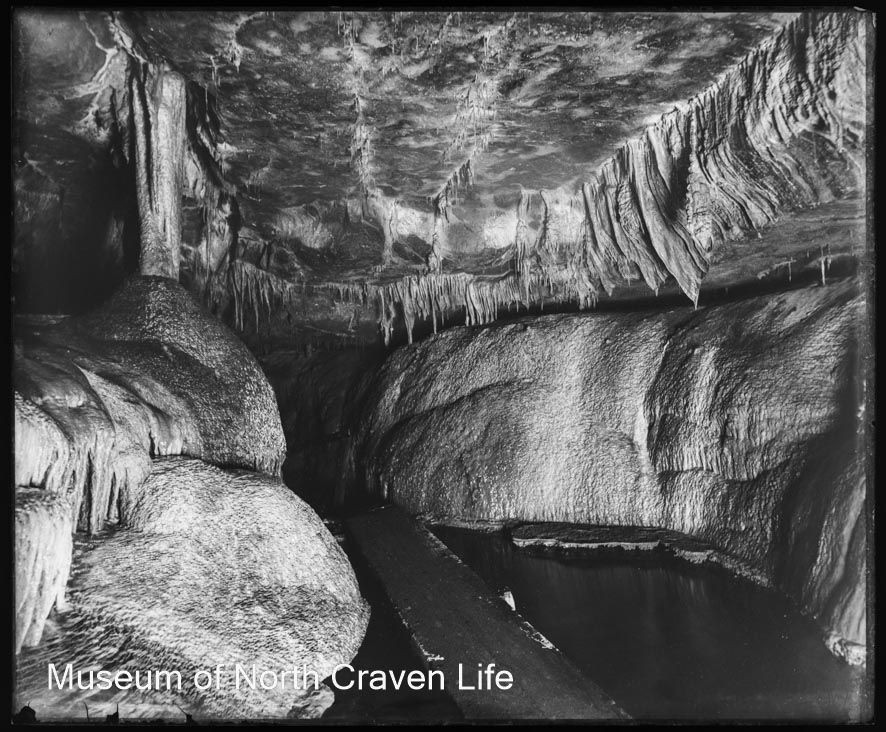
Stalactites in Ingleborough Cave, Horner Photographic Studio, about 1875 to about 1925, Victorian. The Horner Photographic Collection, Museum of North Craven Life (The Folly), Settle. CC BY 4.0. See the work -
1858
“a yawning entrance at its base, large and wide, which seems to lead, not unlikely, to the Shades themselves. Yes, this is the very spot we have come to visit-Ingleborough Cave!”
A visitor writing in the Settle Chronicle, on an outing with members of the British Association. See the page
Source and note
The Settle Chronicle and North Ribblesdale Advertiser, 1858 volume. Scans held by the Museum of North Craven Life, published by the North Craven Building Preservation Trust (CC BY-NC-SA 4.0), page 45.
The Shades are the underworld of the Greek myths.
-
1860 · 7 July 1860
“the famous Ingleborough Cave, the deepest and most remarkable of all the caves hitherto discovered in the honeycombed flanks of that remarkable hill”
Westmorland Gazette, a newspaper, in the British Newspaper Archive's free search extract. See the page
Source
Westmorland Gazette, 7 July 1860, page 3; the words come from the free extract the British Newspaper Archive's search shows, page 3.
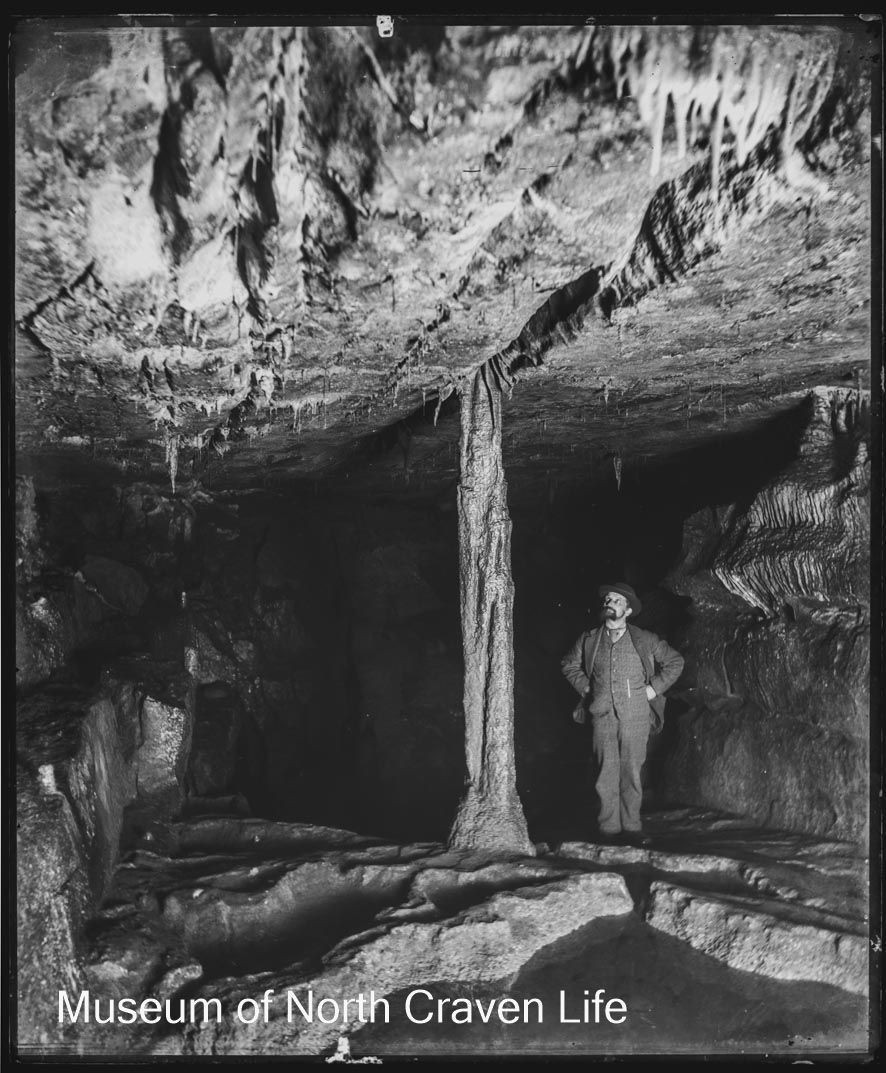
A column in Ingleborough Cave, Horner Photographic Studio, about 1875 to about 1925, Victorian. The Horner Photographic Collection, Museum of North Craven Life (The Folly), Settle. CC BY 4.0. See the work -
1874
“Its circumference in 1839 measured 118 inches, in 1845, 120 inches, and in 1873, I found it to be 128 inches.”
William Boyd Dawkins, geologist and cave explorer. See the page
Source and note
Cave Hunting: Researches on the Evidence of Caves (London: Macmillan, 1874), page 39.
'It' is the Jockey Cap, a stalagmite in the cave.
-
1892
“Nothing was known of the extensive ramifications beyond until 1837”
Harry Speight, Craven historian and walker. See the page
Source
The Craven and North-West Yorkshire Highlands (London: Elliot Stock, 1892), page 154.
-
1892
“Having been watched, it is calculated to be made up of the accumulated droppings of 305 years.”
Harry Speight, Craven historian and walker. See the page
Source and note
The Craven and North-West Yorkshire Highlands (London: Elliot Stock, 1892), page 156.
'It' is the Jockey Cap. Phillips had put its age at 259 years in 1853.


Visit
From the guide. Nobody pays to be here.
Ingleborough Cave
Visitors walk a woodland trail from Clapham, then go 500 metres underground.