UK · England · North Yorkshire · Craven · Settle and Ribblesdale
Giggleswick
With children
In 1772 the church here paid a man called John Higson ten shillings a year. His job was to whip the dogs out of the church, and to keep the doors shut. Not far away there is a well that is said to rise and fall by itself. In 1773 Thomas Pennant waited to watch it. The well stayed still. He ran out of patience and went on his way.
This story comes from the Giggleswick churchwardens' book, in 1772, and Thomas Pennant, writing in 1773.
When you get there Count the dogs you meet on the way today.
What the writers say
Nearly every writer stops at the Ebbing and Flowing Well, from Drayton's poem of 1612 to Pennant, who gave up waiting for it. The church is the other theme. In 1659 a Quaker landed on the ice after a beating in the church. In 1772 the parish's Four and Twenty gave John Higson ten shillings a year to whip the dogs out.
-
1086
“Manor. In Ghigelesvvic Fech had four carucates to be taxed.”
Domesday Book, the Conqueror's survey of 1086, in Speight's English. See the page
Source and note
Harry Speight, The Craven and North-West Yorkshire Highlands (London: Elliot Stock, 1892), page 73.
Whitaker (1805, p. 124) calls carucates 'plowlands': land measured for the tax called the geld. The scan prints the Domesday spelling with vv for w.
-
1612
“At Giggleswick, where I a fountain can you show, That eight times in a day is said to ebb and flow”
Michael Drayton, poet, in Poly-Olbion (1612), Song 28. See the page
Source and note
Thomas Dunham Whitaker, The History and Antiquities of the Deanery of Craven (London, 1805), page 122.
Whitaker (p. 123) says this passage is, as far as he knows, the first notice of the Ebbing and Flowing Well.
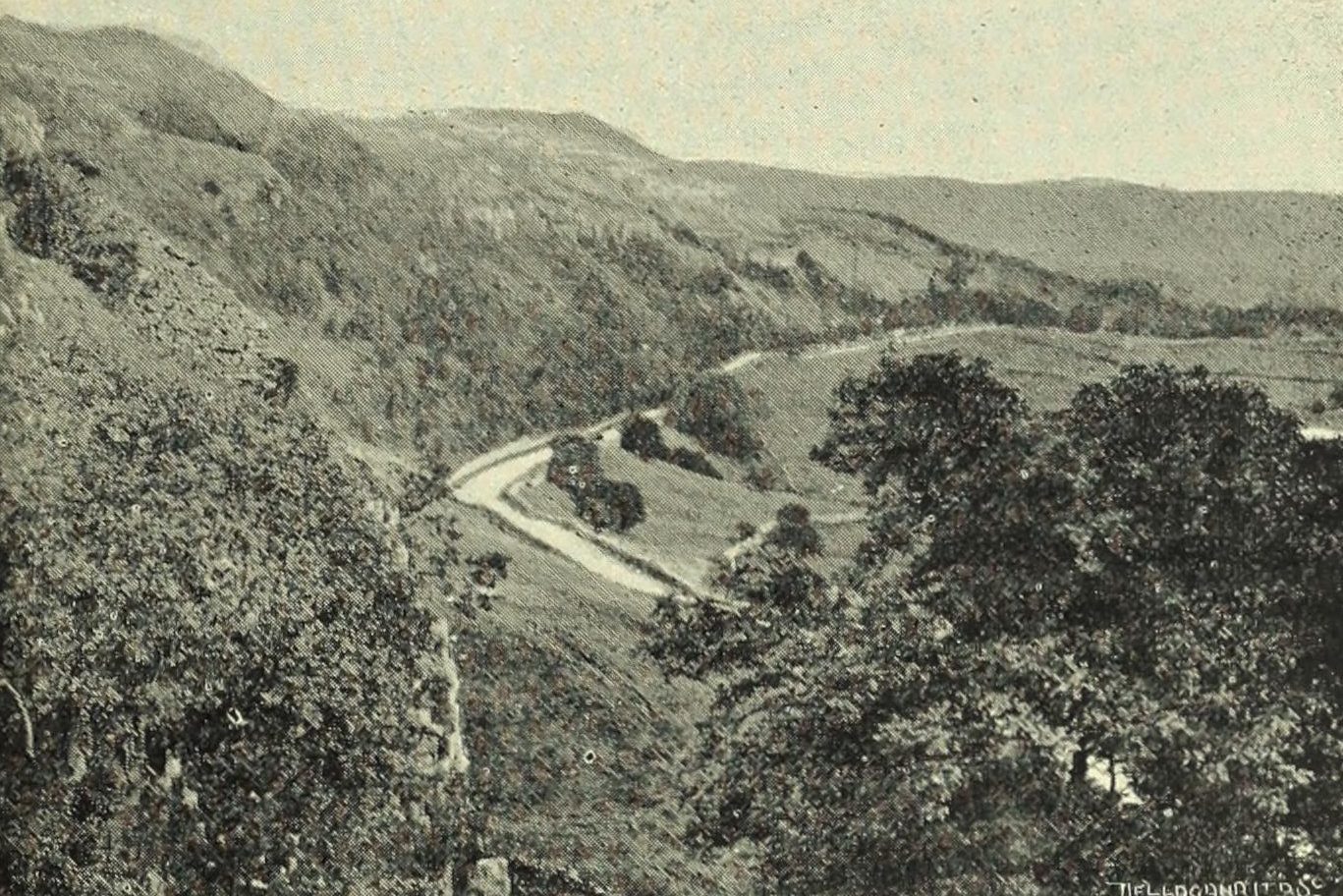
Giggleswick Scars, E. Handby (photograph). From Harry Speight, The Craven and North-West Yorkshire Highlands (London: Elliot Stock, 1892). See the page -
1659
“when he was pulled down, and his head broke against the seats, and was afterwards haled out, and thrown upon the ice”
Samuel Watson, Quaker of Knight Stainforth, from his memoirs for 1659. See the page
Source and note
Harry Speight, The Craven and North-West Yorkshire Highlands (London: Elliot Stock, 1892), page 93.
Speight says this happened when Watson came to speak "in the Steeple House at Giggleswick", the parish church. The scan misprints the place name, so the quote starts after it.
-
1769 · 12 October 1769
“a village with a small piece of water by its side cover'd over with coots: near it a Church, which belongs also to Settle”
Thomas Gray, poet, touring the north. See the page
Source and note
Thomas Gray, journal of his tour, 1769, in The Letters of Thomas Gray, ed. Duncan C. Tovey, vol. III (London: George Bell, 1900), page 261.
Gray is describing Giggleswick.
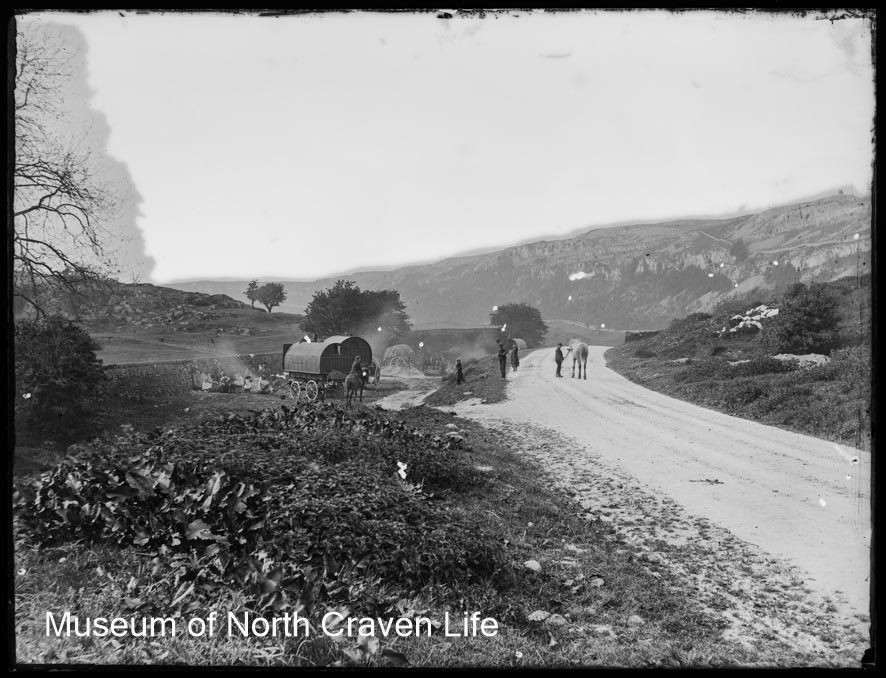
Romany camp, Giggleswick, Horner Photographic Studio, 1890 to 1920, Victorian. The Horner Photographic Collection, Museum of North Craven Life (The Folly), Settle. CC BY 4.0. See the work -
1772 · 11 August 1772
“Also that John Higson is to have ten shillings per year for whiping the dogs out of the Church and keeping the doors shutt.”
Giggleswick churchwardens' book, the parish's Four and Twenty, at their meeting. See the page
Source
Thomas Brayshaw, Churchwardens of Giggleswick, 1638-1883 (Stackhouse, near Settle, 1884), page 20.
-
1773 · 1773 (printed 1801)
“It is a well of small size, which ebbs and flows once in a quarter of an hour, and sometimes with that force as to rise a foot high. I watched it for some time, but it happened to be quiescent ; my patience was exhausted, and I pursued my journey.”
Thomas Pennant, naturalist and travel writer. See the page
Source
Thomas Pennant, A Tour from Downing to Alston-Moor (London, 1801), page 113.
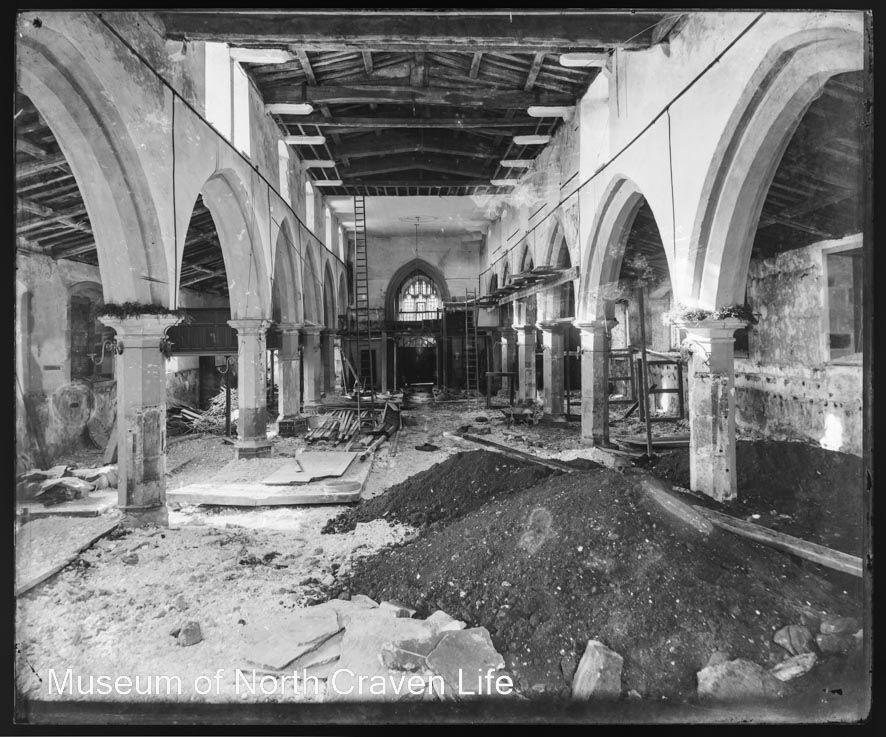
St Alkelda's church during its restoration, Giggleswick, Horner Photographic Studio, about 1875 to about 1925, Victorian. The Horner Photographic Collection, Museum of North Craven Life (The Folly), Settle. CC BY 4.0. See the work -
1805
“an ebbing and flowing well, which issues from the face of a long ridge of rock skirting the road from Settle to Clapham. ... within the last four or five years it has been observed to rise and fall nineteen inches in the space of five minutes. ... Sometimes it is completely dry, and then on a sudden heard to issue from the recesses of its native rock, with a hollow gurgling sound.”
Thomas Dunham Whitaker, historian of Craven. See the page
Source
Thomas Dunham Whitaker, The History and Antiquities of the Deanery of Craven (London, 1805), page 122.
-
1811 · 26 October 1811
“The reciprocating spring at Giggleswick, in Yorkshire, has always been viewed by the Tourists as a”
Westmorland Advertiser and Kendal Chronicle, a newspaper, in the British Newspaper Archive's free search extract. See the page
Source and note
Westmorland Advertiser and Kendal Chronicle, 26 October 1811, page 4; the words come from the free extract the British Newspaper Archive's search shows, page 4.
The reciprocating spring is the Ebbing and Flowing Well. The extract stops mid-sentence.
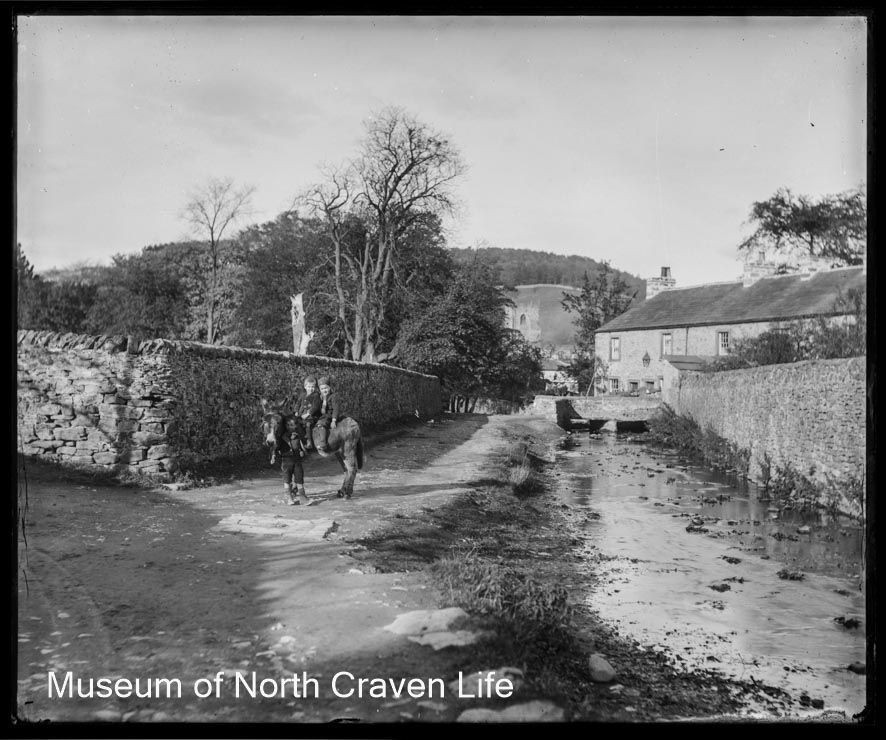
Boys on a donkey, Tems Side, Giggleswick, Horner Photographic Studio, about 1875 to about 1925, Victorian. The Horner Photographic Collection, Museum of North Craven Life (The Folly), Settle. CC BY 4.0. See the work -
1823 · 15 May 1823
People of Giggleswick petitioned Parliament to end slavery in 1823.
“of Gentlemen, Clergy, Bankers, Merchants, and ... of-the parish of Giggleswick ... praying, That the House will adopt such measures, as in their wisdom may be deemed most effectual for mitigating the severities of Slavery, and finally abolishing it throughout the British dominions”
Journals of the House of Commons, Parliament's own record of each day's business. See the page
Source and note
Journals of the House of Commons, vol. 78, 4 February to 25 November 1823, page 312.
Thirty-five petitions came before the House that day. Giggleswick's sat beside petitions from Liverpool, Bristol and Bath.
-
1828 · 19 January 1828
“on the presentation of a piece of plate, by the gentlemen educated at the above school, to their late master, the Rev. Rowland”
Lancaster Gazette, a newspaper, in the British Newspaper Archive's free search extract. See the page
Source and note
Lancaster Gazette, 19 January 1828, page 4; the words come from the free extract the British Newspaper Archive's search shows, page 4.
The extract stops at the master's first name.
-
1850
“A lake only is wanting; but thirty years ago this desideratum was not looked for in vain. The site where the waters of Giggleswick Tarn once stood may be easily distinguished”
William Howson, writer of a Settle guide. See the page
Source
William Howson, An Illustrated Guide to the Curiosities of Craven (London and Settle, 1850), page 56.
-
1853
“The Hambleton hills, the Wolds, no less than Giggleswick Scar, were cliffs against a wide sea.”
John Phillips, geologist. See the page
Source
John Phillips, The Rivers, Mountains, and Sea-Coast of Yorkshire (London, 1853), page 11.
-
1858
“He was hastening home, "wijust a drappie inhisee," and taking the nearest "cuts," one of which he missed, and so stepped into thin air over Giggleswick Scar.”
Jeremy, a visitor writing in the Settle Chronicle, a walker whose series, Craven Reminiscences, ran in the town's paper under the name Jerry Daffelem. See the page
Source and note
The Settle Chronicle and North Ribblesdale Advertiser, 1858 volume, p. 13, 'Craven Reminiscences continued'. Scans held by the Museum of North Craven Life, published by the North Craven Building Preservation Trust under CC BY-NC-SA 4.0 (https://thefolly.org.uk/?p=3707), page 13.
The scan runs words together here: "wi' just a drappie in his ee", with just a drop in his eye.
-
1861
“I saw a well, A well it was to me And it was nothing more. It neither ebbed nor flowed whilst I was there.”
Settle Chronicle, a comic dialogue, a visitor who saw the Ebbing and Flowing Well. See the page
Source
The Settle Chronicle and North Ribblesdale Advertiser, 1861 volume. Scans held by the Museum of North Craven Life, published by the North Craven Building Preservation Trust (CC BY-NC-SA 4.0), page 25.
-
1892
“the discovery of the skull of a horse in the vicinity of where the buried tomb-stone was found”
Harry Speight, author of a guide and history of Craven. See the page
Source and note
Harry Speight, The Craven and North-West Yorkshire Highlands (London: Elliot Stock, 1892), page 132.
Speight means the tomb of one of the Knights of Stainforth, found in Giggleswick church during its restoration.
-
1892
“A good story is related of a South country gentleman unacquainted with the erratic movements of this singular spring, who some few years ago chanced to ride this way from Kendal upon a valuable horse. ... when to his great astonishment, and no less alarm, he found that the horse had literally "drunk the well dry." ... The surgeon perceiving at once the cause of the gentleman's discomfiture, confidently prescribed some harmless remedy, drew a double fee, on the strength of his assurances, and heard shortly afterwards that the horse had speedily recovered !”
Harry Speight, author of a guide and history of Craven. See the page
Source and note
Harry Speight, The Craven and North-West Yorkshire Highlands (London: Elliot Stock, 1892), page 104.
The spring is the Ebbing and Flowing Well, beside the Clapham road at the foot of Buckhaw Brow. Speight puts it about a mile and a half from Settle. The surgeon is a vet in Settle, where the gentleman led his horse.
-
1892
“When the water begins to ebb there may occasionally be observed what is locally called the "silver cord," a thin silvery line like a wisp of straw stretching across the well below the gratings. It lasts but for a moment, suddenly breaking in the middle and disappearing at each end. ... it is considered a portent of good luck to those who witness this additional phenomenon.”
Harry Speight, author of a guide and history of Craven. See the page
Source and note
Harry Speight, The Craven and North-West Yorkshire Highlands (London: Elliot Stock, 1892), page 103.
The well is the Ebbing and Flowing Well. Speight says that in very many visits he saw the silver cord only once.
Visit
From the guide. Nobody pays to be here.
The Harts Head, Giggleswick
The Harts Head is an inn on the main road through Giggleswick.
“Giggleswick, the Hart's Head.”
William Howson, 1850. See the page