UK · England · North Yorkshire · Craven · In Settle
Holy Ascension Church

With children
One day in 1856 a storm broke over Settle while children were in this church. The children heard a crackle, like a loud match being struck. One girl felt a pain strike her eyes. Someone saw a spark of fire burst in the air, just above the children's heads.
This story comes from the Settle Chronicle, in 1856, and Harry Speight, writing in 1892.
When you get there Most old churches point east. Harry Speight noticed that this one stands north and south. Use the sun, or a phone's compass, to check which way it points.
Answer a question to collect the stamp · Stop 6 on Settle town trail · A family day in Settle
-
1856
“as the lightning fell, a curious crackling sound, resembling the report of a loud lucifer match, was heard in the Church, two or three times. Two children sitting near the place from which the sound appeared to proceed ... One of them felt a pain strike her eyes ... distinctly saw a spark of fire explode about the middle of the chancel, just above the heads”
Settle Chronicle, the monthly Settle paper. See the page
Source and note
The Settle Chronicle and North Ribblesdale Advertiser, 1856 volume. Scans held by the Museum of North Craven Life, published by the North Craven Building Preservation Trust (CC BY-NC-SA 4.0), page 43.
It happened during a thunderstorm on a Sunday, while older children from the Sunday School sat in church. The schoolmaster saw the spark. The cuts drop words the scan misreads, among them 'The schoolmaster' and the last words, 'of the children'.
-
1892
“In the year of Her Majesty's accession a church was built at Settle. It is in the Early English style, and comprises a chancel, nave, and embattled tower at the west end. It has a neat interior, but a peculiarity in the construction of the church is that it stands north and south.”
Harry Speight, author of a guide and history of Craven. See the page
Source and note
Harry Speight, The Craven and North-West Yorkshire Highlands (London: Elliot Stock, 1892), page 86.
Queen Victoria's accession was in 1837. Howson (1850) and Thomson (1879) both date the church to 1837.
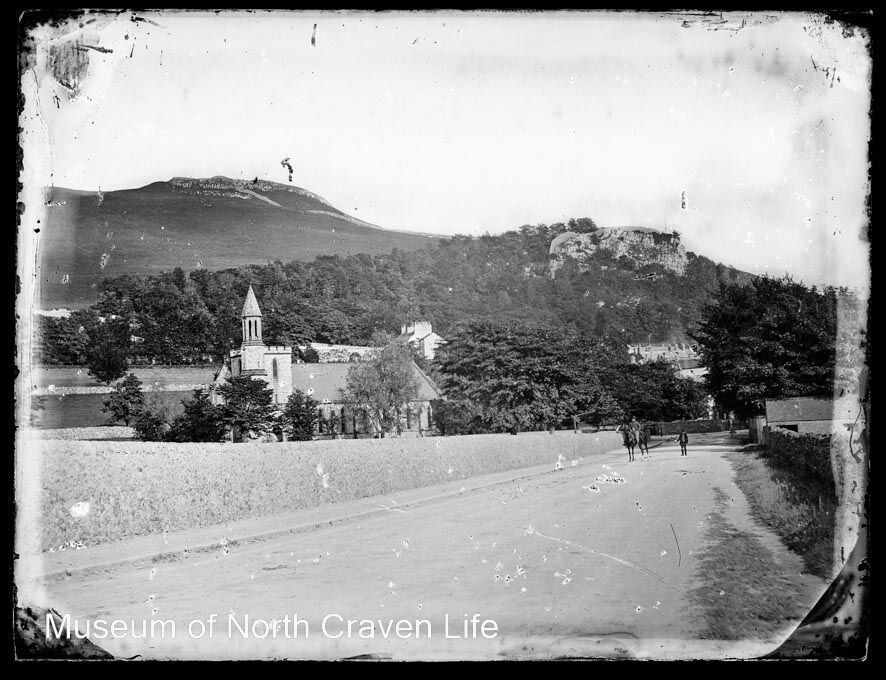
Holy Ascension church from the road, before the railway, Horner Photographic Studio, up to about 1885. The Horner Photographic Collection, Museum of North Craven Life (The Folly), Settle. CC BY 4.0. See the work