UK · England · North Yorkshire · Craven · Settle and Ribblesdale
Long Preston

What the writers say
Domesday names a church here in 1086. Whitaker says the place took its name from the church's priest. Dayes in 1803 found a cheerful, comfortable village making calico. James Ray wrote in 1749 that a sergeant, a drummer and a woman took Manchester for Prince Charles in 1745, and Speight says she was Long Preston Peggy.
-
1086
“Manor. In Prestune (Long Preston) Ulf had three carucates to be taxed, and one church.”
Domesday Book, the Conqueror's survey of 1086, in Speight's English. See the page
Source and note
Harry Speight, The Craven and North-West Yorkshire Highlands (London: Elliot Stock, 1892), page 366.
Speight says it is the only Yorkshire church between Bentham and Kildwick in the survey.
-
1745 · 1745 (printed 1749)
“was taken by a Sergeant, a Drum, and a Woman, about two o'clock in the afternoon”
James Ray, author of a History of the Rebellion (York, 1749). See the page
Source and note
Harry Speight, The Craven and North-West Yorkshire Highlands (London: Elliot Stock, 1892), page 373.
Ray means Manchester, which a sergeant, a drummer and a woman took for Prince Charles in 1745. Speight says the woman was "Long Preston Peggy".
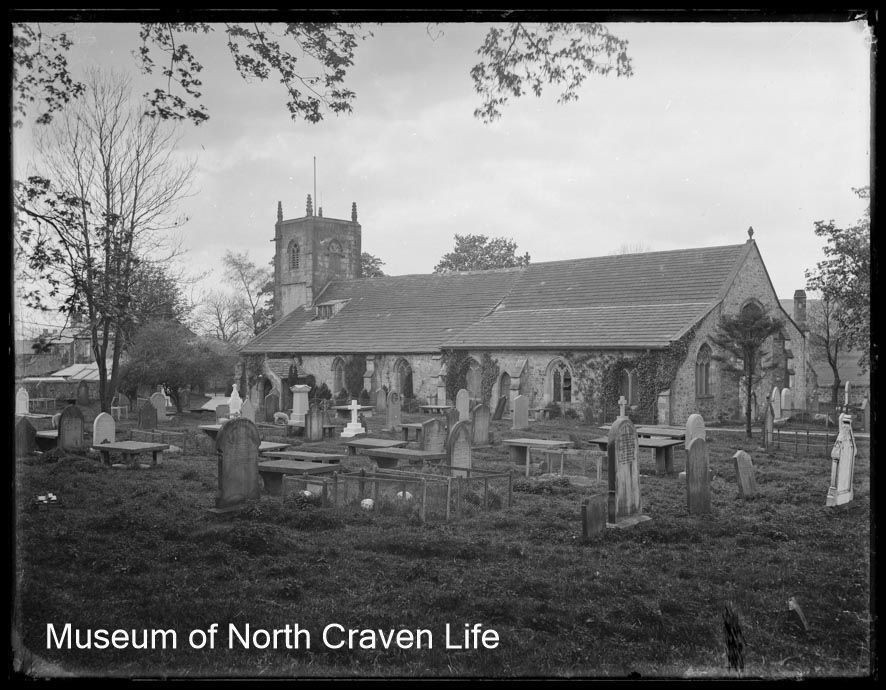
St Mary the Virgin, Long Preston, Horner Photographic Studio, about 1875 to about 1925, Victorian. The Horner Photographic Collection, Museum of North Craven Life (The Folly), Settle. CC BY 4.0. See the work -
1803
“an opulent place, where the people appear cheerful, their houses clean, and everything carries with it an air of comfort." He also adds, "great quantities of calico are made here.”
Edward Dayes, painter, in his Picturesque Tour (1803). See the page
Source
Harry Speight, The Craven and North-West Yorkshire Highlands (London: Elliot Stock, 1892), page 365.
-
1805
“The church of Preston, from the residence of whose incumbent the place derived its name, evidently existed in the Saxon times.”
Thomas Dunham Whitaker, historian of Craven. See the page
Source
Thomas Dunham Whitaker, The History and Antiquities of the Deanery of Craven (London, 1805), page 111.
-
1830 · 22 November 1830
Giggleswick and Long Preston petitioned Parliament against slavery in 1830.
“of Inhabitants of Giggleswick ;—of Middlesmoor ;—of Howden ;—of Bubwith ;—of Haddenham ;—of Long Preston ... were presented, and read ; praying for the abolition of Colonial Slavery”
Journals of the House of Commons, Parliament's own record of each day's business. See the page
Source and note
Journals of the House of Commons, vol. 86, 14 September 1830 to 22 November 1831, page 126.
People in Giggleswick and Long Preston sent petitions to Parliament against slavery in the colonies.
-
1855 · June 1855
“On Monday, June 4th, a son of Mr. Cook Station Master, Long Preston, met with his death in the following manner ... approaching too near he was caught in the ... shaft, and tho' quickly released it was too late to save his life”
Settle Chronicle, the monthly Settle paper. See the page
Source and note
The Settle Chronicle and North Ribblesdale Advertiser, 1855 volume. Scans held by the Museum of North Craven Life, published by the North Craven Building Preservation Trust (CC BY-NC-SA 4.0), page 28.
He had taken a message to the corn mill. The scan prints 'the the shaft'.


