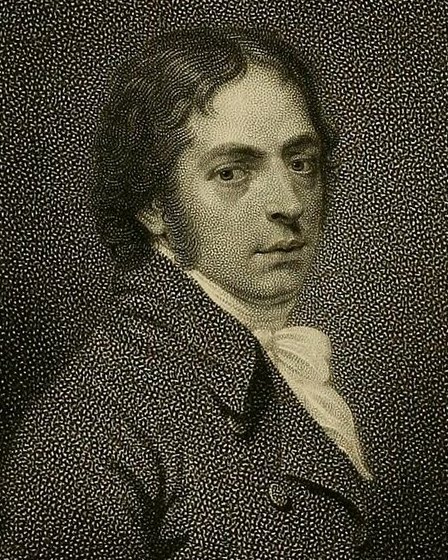
Who they were
Dayes was born in 1763, and became a watercolour painter and mezzotint engraver.
From Dictionary of National Biography, vol. 14, 'Dayes, Edward', by William Cosmo Monkhouse: “watercolour painter and engraver in mezzotint, was born in 1763” See the page
He studied under William Pether, and first showed at the Royal Academy in 1786.
From Dictionary of National Biography, vol. 14, 'Dayes, Edward', by William Cosmo Monkhouse: “He studied under William Pether, and began to exhibit at the Royal Academy in 1786” See the page
He taught Thomas Girtin, and his work shows in Turner's early drawings.
From Dictionary of National Biography, vol. 14, 'Dayes, Edward', by William Cosmo Monkhouse: “He was the master of Girtin, and his influence is perceptible in the early drawings of Turner.” See the page
He was draughtsman to the Duke of York.
From Dictionary of National Biography, vol. 14, 'Dayes, Edward', by William Cosmo Monkhouse: “He was draughtsman to the Duke of York.” See the page
His wife painted miniatures, and showed four at the Royal Academy.
From Dictionary of National Biography, vol. 14, 'Dayes, Edward', by William Cosmo Monkhouse: “His wife painted miniatures and exhibited four works at the Royal Academy between 1797 and 1800.” See the page
He took his own life at the end of May 1804.
From Dictionary of National Biography, vol. 14, 'Dayes, Edward', by William Cosmo Monkhouse: “He died by his own hand at the end of May 1804.” See the page
After his death a friend gathered his writings into a book for the good of his widow.
From Dictionary of National Biography, vol. 14, 'Dayes, Edward', by William Cosmo Monkhouse: “After his death his works were collected and edited by E. W. Bradley, and published for the benefit of his widow in 1805.” See the page
In Craven
Dayes thought the houses of Settle the oddest he had met anywhere.
From The Works of the late Edward Dayes: containing An Excursion through the Principal Parts of Derbyshire and Yorkshire, ed. E. W. Brayley (London, 1805), page 56: “the houses being the most whimsical, picturesque, and odd, any where to be met with” See the page
To him the market place at Settle did not look like England at all.
From The Works of the late Edward Dayes: containing An Excursion through the Principal Parts of Derbyshire and Yorkshire, ed. E. W. Brayley (London, 1805), page 56: “The market-place, in particular, had, to me, the strangest effect imaginable; it not appearing like English nature.” See the page
He told travellers to hire a post-chaise at the Golden Lion in Settle to reach Gordale.
From The Works of the late Edward Dayes: containing An Excursion through the Principal Parts of Derbyshire and Yorkshire, ed. E. W. Brayley (London, 1805), page 62: “A post-chaise may be had at the Golden Lion, at Settle” See the page
From Settle he went north to Askrigg.
From The Works of the late Edward Dayes: containing An Excursion through the Principal Parts of Derbyshire and Yorkshire, ed. E. W. Brayley (London, 1805), page 80: “From Settle I proceeded to Askrigg” See the page
The journey
A walk from Ashbourne to York, through Craven. Dayes gives no year for the walk. The book came out in 1805, the year after he died..
Craven is stops 13 to 25 of 39, between Otley Chevin and Semerwater. Light dots are stops inside Craven. Each stop is a place the writer names, and their words are listed under the maps. Straight lines join the stops. We do not know every road they took.
“great object of this pedestrian Excursion, was to visit the North and West Ridings of Yorkshire” See the page
The stretch in Craven
How we know each stop: all 39, in the writer's own words
1. Ashbourne
“the narrative of my journey, which I commenced from ASHBOURN, DERBYSHIRE”, page 2. See the page
Dayes spells it Ashbourn.
2. Dovedale
“I quitted Ashbourn, full of impatience to visit Dove-Dale ... Night coming on, I left this enchanting place with a sigh”, page 4. See the page
3. Newhaven
“over a moorish country, I came to New-Haven”, page 10. See the page
He walked here from Dovedale by Hanson Grange, a farm, with a pocket compass.
4. Haddon Hall
“I struck across the meadows, into the Matlock road to Bakewell, to visit HADDON HALL”, page 11. See the page
5. Beauchief Abbey
“I turned into an indifferent cross road, which, at the end of two miles of pleasant country, conducted me to BEAUCHIEF”, page 15. See the page
6. Sheffield
“From Beauchief I wandered two miles through the fields, to a romantic place, called Smithy-wood Bottom, on the Chesterfield road ; two miles further brought me to SHEFFIELD”, page 17. See the page
7. Rotherham
“From Rotherham I proceeded about six miles through a pleasant country to Maltby”, page 21. See the page
8. Roche Abbey
“ROCHE ABBEY ... The walk, in which I stood, was dark”, page 21. See the page
He walked out to the abbey from Maltby and back.
9. Conisbrough Castle
“to CONISBOROUGH ... some parts, that I measured”, page 25. See the page
Dayes spells it Conisborough.
10. Pontefract
“I struck across a common to the left, and then by a cross road proceeded to PONTEFRACT”, page 29. See the page
On the way he crossed the Don by ferry and passed Melton on the Hill, Marr and Robin Hood's Well.
11. Kirkstall Abbey
“On ascending the hill behind the Abbey, I had a fine view of the whole building”, page 44. See the page
He describes Wakefield and Leeds before Kirkstall, but only as a guidebook would.
12. Otley Chevin
“The Chevin Hill, on which I stood, formed a bold fore-ground : below me appeared the town of Otley”, page 44. See the page
13. Skipton · Craven
“I first observed this effect in the neighbourhood of Skipton”, page 129. See the page
He means the bright colours of the country. He describes Skipton Castle and its family picture in detail.
14. Coniston Cold · Craven
“Entering on the moors at Cold Coniston, I proceeded”, page 55. See the page
Dayes calls it Cold Coniston. He mentions Gargrave just before, but only as a guide would.
15. Hellifield · Craven
“I proceeded to the village of Hellyfield”, page 55. See the page
Dayes spells it Hellyfield. The scan's text read it as Hellyjield, and we corrected that one word in our copy from the page image.
16. Long Preston · Craven
“then to Long Preston, an opulent place, where the people appear cheerful, their houses clean”, page 55. See the page
17. Settle · Craven
“From Skipton it is sixteen miles to SETTLE ... The market-place, in particular, had, to me, the strangest effect imaginable”, page 56. See the page
18. Malham Cove · Craven
“With a guide, I made an excursion over the moors to MALHAM ... MALHAM-COVE, Pronounced Maum-Cove, by the natives”, page 60. See the page
He made this excursion from Settle and came back to Settle.
19. Malham · Craven
“Passing through the village of Malham, which is composed of a few scattered houses”, page 60. See the page
20. Gordale Scar · Craven
“myself and guide, with some difficulty, ascended the craggs up the fall”, page 63. See the page
Dayes heads this passage Gordale-Scar.
21. Malham Tarn · Craven
“Hence I proceeded to MALHAM TARN”, page 65. See the page
22. Settle · Craven
“From Settle I proceeded to Askrigg, a distance of about twenty-four miles”, page 80. See the page
23. Horton in Ribblesdale · Craven
“From Horton ... I immediately entered on the moors, where all is dreary, wild, and solitary”, page 85. See the page
24. Hunt Pot · Craven
“I was surprised by a most horrid roaring to the right ... I think this place is called Hunt-Pot”, page 85. See the page
Dayes was not sure of the name himself.
25. Ling Gill · Craven
“the road again brought me to the edge of a precipice, where the river Ribble is dashed from rock to rock ... Probably the place named Lingill”, page 85. See the page
Dayes was not sure of the name himself. He walked on over Cam in heavy rain, with Ingleborough behind him.
26. Semerwater
“In my descent to Askrigg, I passed a lake, called Semer-mere”, page 90. See the page
27. Askrigg
“ASKRIGG. ... I put up at the King's Arms Inn in this town, very wet and tired”, page 91. See the page
He describes Ingleton and its caves after this, but from another book, not from his own visit.
28. Aysgarth Falls
“at the end of about a mile, I arrived at ASGARTH FORCE”, page 94. See the page
Dayes spells it Asgarth Force.
29. Castle Bolton
“brought me again into the Richmond road, at the village of Carperby ... The road which is seen from Bolton Castle”, page 95. See the page
30. Wensley
“At Wensley I again met the road, and crossed the bridge over the Ure into the road to Middleham”, page 100. See the page
31. Middleham
“MIDDLEHAM Is a small town ... I measured the party-wall, of one of the chambers, which was fourteen feet in thickness”, page 103. See the page
He describes Richmond and Jervaulx Abbey next, but only as a guide would, so the order is unclear there.
32. Masham
“Three miles from Masham brought me to”, page 116. See the page
33. Hackfall
“Three miles from Masham brought me to HACK-FALL”, page 116. See the page
34. Fountains Abbey and Studley Royal
“FOUNTAINS ABBEY ... For myself, I appeared to tread on enchanted ground”, page 127. See the page
He reached Studley from Ripon, which he describes as a guide would.
35. Sutton-under-Whitestonecliffe
“A few miles ramble brought me to the village of Sutton”, page 139. See the page
He came here by Thirsk and climbed Sutton Bank.
36. Duncombe Park
“The Saloon at Duncombe ... In my opinion, it is by no means a first-rate piece of sculpture”, page 144. See the page
37. Rievaulx Abbey
“RIEVALE ABBEY ... My approach to the Abbey was by the valley”, page 147. See the page
Dayes spells it Rievale.
38. Easingwold
“Five miles further, I entered the great north road, at a market- town called Easingwold”, page 154. See the page
He came here by Byland Abbey and Coxwold.
39. York
“At York I terminated my Pedestrian Excursion, and proceeded immediately by the coach to London”, page 185. See the page
From Edward Dayes, An Excursion through the Principal Parts of Derbyshire and Yorkshire, in The Works of the Late Edward Dayes, with notes by E. W. Brayley (London: Mrs. Dayes and others, 1805).
1 quote on 1 place
A bigger dot means more quotes. Tap a dot to open the place.
What they wrote
-
1803
“an opulent place, where the people appear cheerful, their houses clean, and everything carries with it an air of comfort." He also adds, "great quantities of calico are made here.”
Edward Dayes, painter, in his Picturesque Tour (1803). See the page
Source
Harry Speight, The Craven and North-West Yorkshire Highlands (London: Elliot Stock, 1892), page 365.