Who they were
At midwinter 1085 King William talked at length with his council about the land: how it was held, and by whom.
From The Anglo-Saxon Chronicle, edited by J. A. Giles, new edition (London: G. Bell and Sons, 1914), the year 1085, page 156: “the king had a great consultation, and spoke very deeply with his witan concerning this land, how it was held and what were its tenantry.” See the page
He sent his men into every shire of England.
From The Anglo-Saxon Chronicle, edited by J. A. Giles, new edition (London: G. Bell and Sons, 1914), the year 1085, page 156: “He then sent his men over all England, into every shire” See the page
They counted the land in each shire, the land the king held, the cattle, and what each should pay him every year.
From The Anglo-Saxon Chronicle, edited by J. A. Giles, new edition (London: G. Bell and Sons, 1914), the year 1085, page 156: “caused them to ascertain how many hundred hides of land it contained, and what lands the king possessed therein, what cattle there were in the several counties, and how much revenue he ought to receive yearly from each.” See the page
They wrote down the land and the cattle that every person in England held.
From The Anglo-Saxon Chronicle, edited by J. A. Giles, new edition (London: G. Bell and Sons, 1914), the year 1085, page 157: “what property every ... inhabitant of all England possessed in land or in cattle” See the page
The chronicler wrote that they did not miss a single ox, cow or pig. Then they brought all the writings to the king.
From The Anglo-Saxon Chronicle, edited by J. A. Giles, new edition (London: G. Bell and Sons, 1914), the year 1085, page 157: “was there an ox, or a cow, or a pig passed by, and that was not set down in the accounts ... and then all these writings were brought to him.” See the page
When William died, the chronicler wrote that he knew who held every hide of land, and what it was worth.
From The Anglo-Saxon Chronicle, edited by J. A. Giles, new edition (London: G. Bell and Sons, 1914), the year 1087, page 160: “there was not a single hide of land throughout the whole, of which he knew not the possessor, and how much it was worth, and this he afterwards entered in his register.” See the page
An editor's note calls the survey of 1085 the making of Domesday Book.
From The Anglo-Saxon Chronicle, edited by J. A. Giles, new edition (London: G. Bell and Sons, 1914), note to the year 1087, page 160: “an evident allusion to the compilation of Doomsday Book already described, a.d. 1085” See the page
In Craven
Whitaker built his history of property in early Craven on Domesday.
From Thomas Dunham Whitaker, The History and Antiquities of the Deanery of Craven (London, 1805), page 9: “I shall assume this invaluable record, as the basis of a general investigation into the antient state of property in Craven” See the page
In Craven the king held 115 carucates, a measure of ploughland, and 77 of them were waste. All 63 of William de Percy's were waste.
From Thomas Dunham Whitaker, The History and Antiquities of the Deanery of Craven (London, 1805), page 9: “Of these the king held 115, of which 77 were waste. William de Perci 63, all waste.” See the page
From the survey Whitaker reckoned that more than six parts in seven of Craven lay waste under the Conqueror.
From Thomas Dunham Whitaker, The History and Antiquities of the Deanery of Craven (London, 1805), page 9: “so that more than six parts out of seven lay waste in the reign of the Conqueror” See the page
20 quotes on 20 places
A bigger dot means more quotes. Tap a dot to open the place.
What they wrote
-
1086
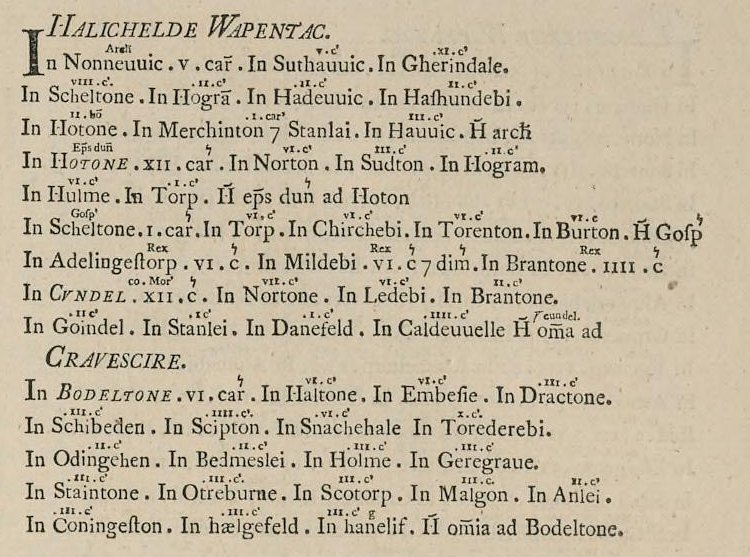
“Airtone. Arnebrand.”
Domesday Book, the king's survey of England. See the page
Source and note
Thomas Dunham Whitaker, The History and Antiquities of the Deanery of Craven (London, 1805), page 174.
Whitaker prints the entry in Domesday's own Latin shorthand. It names Arnebrand as the holder of Airtone. The scan garbles the number of carucates that follows.
-
1086
“In Oustewic and Heldetune (Austwick and Eldroth (?)) ... These Torfin had for twelve manors. In these are forty-three carucates to be taxed.”
Domesday Book, the king's survey of 1086, in Speight's English. See the page
Source
Domesday Book (1086), translated in Harry Speight, The Craven and North-West Yorkshire Highlands (1892), page 162.
-
1086
“Chetel had four manors, and there are in them eighteen carucates to be taxed, and three churches.”
Domesday Book, the Conqueror's survey of 1086, in Speight's English. See the page
Source and note
Harry Speight, The Craven and North-West Yorkshire Highlands (London: Elliot Stock, 1892), page 185.
Speight says the three churches were Bentham, Tatham and Tunstall.
-
1086
“Borctune (Burton-in-Lonsdale) four carucates”
Domesday Book, the Conqueror's survey of 1086, in Speight's English. See the page
Source
Harry Speight, The Craven and North-West Yorkshire Highlands (London: Elliot Stock, 1892), page 208.
-
1086
“In Oustewic and Heldetune (Austwick and Eldroth (?)) Clapeham (Clapham) ... These Torfin had for twelve manors.”
Domesday Book, the king's survey of 1086, in Speight's English. See the page
Source
Domesday Book (1086), translated in Harry Speight, The Craven and North-West Yorkshire Highlands (1892), page 162.
-
1086
“In Dractone ... three carucates”
Domesday Book, the Conqueror's survey of 1086, in Dawson's English. See the page
Source and note
William Harbutt Dawson, History of Skipton (London and Skipton, 1882).
The scan reads 'Dr-augliton' for Draughton. Dawson adds the modern name, Draughton, in brackets; the scan misreads it, so the quote leaves it out.
-
1086
“Manor. In Ghigelesvvic Fech had four carucates to be taxed.”
Domesday Book, the Conqueror's survey of 1086, in Speight's English. See the page
Source and note
Harry Speight, The Craven and North-West Yorkshire Highlands (London: Elliot Stock, 1892), page 73.
Whitaker (1805, p. 124) calls carucates 'plowlands': land measured for the tax called the geld. The scan prints the Domesday spelling with vv for w.
-
1086
“In ... (Halton) six carucates.”
Domesday Book, the Conqueror's survey of 1086, in Dawson's English. See the page
Source and note
William Harbutt Dawson, History of Skipton (London and Skipton, 1882).
The scan reads 'AUone' for Altone. The scan misreads the Domesday name, Altone, so the quote leaves it out.
-
1086
“In Helgeflet (Hellifield) two carucates and a half.”
Domesday Book, the Conqueror's survey of 1086, in Speight's English. See the page
Source and note
Harry Speight, The Craven and North-West Yorkshire Highlands (London: Elliot Stock, 1892), page 360.
Whitaker (1805, p. 124) calls carucates 'plowlands': land measured for the tax called the geld. Speight's second Domesday list, under Long Preston (p. 366), gives another holding here of one carucate and a half.
-
1086
“Inglestune (Ingleton) six carucates”
Domesday Book, the king's survey of 1086, in Speight's English. See the page
Source
Domesday Book (1086), translated in Harry Speight, The Craven and North-West Yorkshire Highlands (1892), page 208.
-
1086
“Manor. In Lanclif (Langcliffe) Fech had three carucates to be taxed.”
Domesday Book, the Conqueror's survey of 1086, in Speight's English. See the page
Source and note
Harry Speight, The Craven and North-West Yorkshire Highlands (London: Elliot Stock, 1892), page 73.
Whitaker (1805, p. 124) calls carucates 'plowlands': land measured for the tax called the geld.
-
1086
“Manor. In Prestune (Long Preston) Ulf had three carucates to be taxed, and one church.”
Domesday Book, the Conqueror's survey of 1086, in Speight's English. See the page
Source and note
Harry Speight, The Craven and North-West Yorkshire Highlands (London: Elliot Stock, 1892), page 366.
Speight says it is the only Yorkshire church between Bentham and Kildwick in the survey.
-
1086
“at the time of the Domesday survey, consisted of the townships or manors of Malgum (now Malham), Chirchebi, Oterburne, Airtone, Scotorp, and Caltun.”
Domesday Book, the king's survey of England. See the page
Source and note
Thomas Dunham Whitaker, The History and Antiquities of the Deanery of Craven (London, 1805), page 174.
Whitaker's summary of the Domesday entries for the parish of Kirkby Malham. Chirchebi is Kirkby.
-
1086
“In Rodemele (Rathmell) two carucates.”
Domesday Book, the Conqueror's survey of 1086, in Speight's English. See the page
Source
Harry Speight, The Craven and North-West Yorkshire Highlands (London: Elliot Stock, 1892), page 73.
-
1086
“Manor. In Anele (Anley) Burun had three carucates of land to be taxed. In Setel three carucates to be taxed.”
Domesday Book, the Conqueror's survey of 1086, in Speight's English. See the page
Source and note
Harry Speight, The Craven and North-West Yorkshire Highlands (London: Elliot Stock, 1892), page 73.
Whitaker (1805, p. 124) calls carucates 'plowlands': land measured for the tax called the geld.
-
1086
“... (Skibedon) three carucates”
Domesday Book, the Conqueror's survey of 1086, in Dawson's English. See the page
Source and note
William Harbutt Dawson, History of Skipton (London and Skipton, 1882).
The scan reads 'Scipcdcn' for Scipeden. The scan misreads the Domesday name, Scipeden, so the quote leaves it out.
-
1086
“Manor. In Stacuse (Stackhouse) Archil had three carucates to be taxed.”
Domesday Book, the Conqueror's survey of 1086, in Speight's English. See the page
Source
Harry Speight, The Craven and North-West Yorkshire Highlands (London: Elliot Stock, 1892), page 73.
-
1086
“Stainforde three carucates.”
Domesday Book, the Conqueror's survey of 1086, in Speight's English. See the page
Source and note
Harry Speight, The Craven and North-West Yorkshire Highlands (London: Elliot Stock, 1892), page 73.
Whitaker (1805, p. 124) calls carucates 'plowlands': land measured for the tax called the geld. The scan breaks the line as 'I n Stainforde'; the quote starts after it.
-
1086
“Toredderli (Thorlby) ten carucates.”
Domesday Book, the Conqueror's survey of 1086, in Dawson's English. See the page
Source
William Harbutt Dawson, History of Skipton (London and Skipton, 1882).
-
1086
“In Wicklesforde (Wigglesworth) one carucate.”
Domesday Book, the Conqueror's survey of 1086, in Speight's English. See the page
Source
Harry Speight, The Craven and North-West Yorkshire Highlands (London: Elliot Stock, 1892), page 366.