UK · England · North Yorkshire · Craven · In Settle
Attermire Scar

With children
Long ago, Harry Speight wrote, old folks and nervous ladies who could not run hid in the caves here. While they hid, they sewed and knitted. Many years later, someone found an old broken knitting needle in Attermire.
This story comes from Harry Speight, writing in 1892, and Jeremy, a visitor writing in the Settle Chronicle, in 1858.
When you get there In 1858 a visitor said these crags look like a giant's staircase, or a ruined castle. What do they look like to you?
Answer a question to collect the stamp · Stop 3 on Victoria Cave and Attermire · A family day in Settle
What the writers say
Howson and the 1858 walker both compare the crags to a castle. Housman warns of the ledge to the cave, and Speight says frightened locals hid in the caves in the war scares and left a knitting needle behind.
-
1800
“The approach to it is not without some danger, the only path leading along a ledge of a rocky precipice”
John Housman, writer of a guide for tourists. See the page
Source
John Housman, A Descriptive Tour, and Guide to the Lakes, Caves, Mountains, and Other Natural Curiosities (Carlisle, 1800), page 27.
-
1850
“a most remarkable assemblage of rocks ; beetling crags, abrupt summits, castellated and perpendicular cliffs are grouped together in a semicircular range”
William Howson, writer of a Settle guide. See the page
Source
William Howson, An Illustrated Guide to the Curiosities of Craven (London and Settle, 1850), page 58.
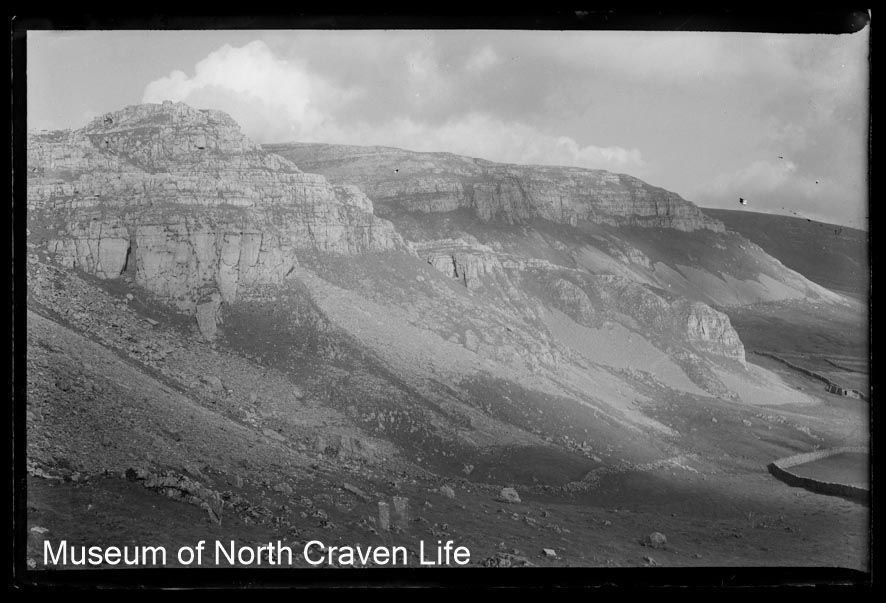
Attermire Scar, Horner Photographic Studio, about 1875 to about 1925, Victorian. The Horner Photographic Collection, Museum of North Craven Life (The Folly), Settle. CC BY 4.0. See the work -
1858
“Some are piled up tier above tier, like the steps of a huge staircase; others are tossed up into beetling precipices; some resemble ,the ruins of a gigantic castle”
Jeremy, a visitor writing in the Settle Chronicle, a walker whose series, Craven Reminiscences, ran in the town's paper under the name Jerry Daffelem. See the page
Source
The Settle Chronicle and North Ribblesdale Advertiser, 1858 volume, p. 13, 'Craven Reminiscences continued'. Scans held by the Museum of North Craven Life, published by the North Craven Building Preservation Trust under CC BY-NC-SA 4.0 (https://thefolly.org.uk/?p=3707), page 13.
-
1892
“they were temporarily furnished and occupied by old folks and nervous ladies "unable to run," who used to sew and knit within these mountain retreats without much fear of discovery. An amusing relic of this period, in the shape of an old broken knitting-needle, was found in Attermire many years ago.”
Harry Speight, author of a guide and history of Craven. See the page
Source and note
Harry Speight, The Craven and North-West Yorkshire Highlands (London: Elliot Stock, 1892), page 127.
Speight means people used the caves this way at the 1745 Rising and in the war scares at the end of the eighteenth century.
-
1902 · 24 September 1902
“the mischievous trick was due to some of the volunteers from Settle who had been practising on the Attermire rifle range during the afternoon”
Nottingham Evening Post, a newspaper, in the British Newspaper Archive's free search extract. See the page
Source and note
Nottingham Evening Post, 24 September 1902, page 3; the words come from the free extract the British Newspaper Archive's search shows, page 3.
The paper's headline: The firing on a Manchester balloon.