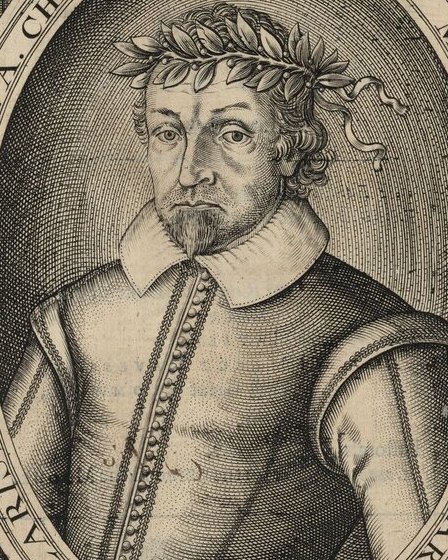
In their own words
“They are a company of base knaves, whom I both scorn and kick at.”
Dictionary of National Biography, vol. 16, 'Drayton, Michael', by Arthur Henry Bullen. See the page
Who they were
Drayton was born at Hartshill, near Atherstone in Warwickshire, in 1563.
From Dictionary of National Biography, vol. 16, 'Drayton, Michael', by Arthur Henry Bullen: “was born at Hartshill, near Atherstone, Warwickshire, in 1563” See the page
He said he owed most of his education to Sir Henry Goodere.
From Dictionary of National Biography, vol. 16, 'Drayton, Michael', by Arthur Henry Bullen: “he acknowledges that he was indebted to Sir Henry Goodere for the ‘most part’ of his education” See the page
John Aubrey said his father was a butcher, but Drayton called himself nobly bred.
From Dictionary of National Biography, vol. 16, 'Drayton, Michael', by Arthur Henry Bullen: “Aubrey says that he was the son of a butcher ... that he was ‘nobly bred’ and ‘well ally'd.’” See the page
The first eighteen songs of Poly-Olbion, his longest poem, came out in 1613.
From Dictionary of National Biography, vol. 16, 'Drayton, Michael', by Arthur Henry Bullen: “The first eighteen songs of Drayton's longest and most famous poem ... appeared in 1613” See the page
John Selden wrote learned notes to each song.
From Dictionary of National Biography, vol. 16, 'Drayton, Michael', by Arthur Henry Bullen: “To each song are appended copious annotations, full of antiquarian learning, by John Selden.” See the page
His famous Ballad of Agincourt first appeared in a book of his odes and eclogues.
From Dictionary of National Biography, vol. 16, 'Drayton, Michael', by Arthur Henry Bullen: “Odes, Eglogs, the Man in the Moone ... Here first appeared the famous ‘Ballad of Agincourt,’” See the page
Ben Jonson told William Drummond that Drayton feared him.
From Dictionary of National Biography, vol. 16, 'Drayton, Michael', by Arthur Henry Bullen: “Jonson stated that ‘Drayton feared him; and he [Jonson] esteemed not of him [Drayton],’” See the page
All his biographers say he never married.
From Dictionary of National Biography, vol. 16, 'Drayton, Michael', by Arthur Henry Bullen: “All his biographers agree that he lived and died a bachelor” See the page
He died in 1631, and lies in Westminster Abbey.
From Dictionary of National Biography, vol. 16, 'Drayton, Michael', by Arthur Henry Bullen: “Drayton died in 1631 and was buried in Westminster Abbey” See the page
In Craven
The second part of Poly-Olbion, with songs 19 to 30, came out in 1622.
From Dictionary of National Biography, vol. 16, 'Drayton, Michael', by Arthur Henry Bullen: “A second part, containing songs xix–xxx, was written later, and the complete poem ... was published in 1622.” See the page
In the poem the Ribble speaks, and names Penyghent as its source.
From Thomas Dunham Whitaker, The History and Antiquities of the Deanery of Craven (London, 1805), page 17: “From Penigent's proud foot as from my source I slide” See the page
He wrote that the well at Giggleswick ebbs and flows eight times a day.
From Thomas Dunham Whitaker, The History and Antiquities of the Deanery of Craven (London, 1805), page 122: “At Giggleswick, where I a fountain can you show, That eight times in a day is said to ebb and flow” See the page
Whitaker found his talking rivers whimsical, but always amusing.
From Thomas Dunham Whitaker, The History and Antiquities of the Deanery of Craven (London, 1805), page 17: “our old poetical topographer Drayton, whose personifications and pleadings of rivers and districts, though often whimsical, are always amusing” See the page
3 quotes on 3 places
A bigger dot means more quotes. Tap a dot to open the place.
What they wrote
-
1622
“And on the bank of Wharfe my pleasant Barden”
Michael Drayton, poet, in Poly-Olbion, where the county of York speaks. See the page
Source
Thomas Dunham Whitaker, The History and Antiquities of the Deanery of Craven (London, 1805), page 17.
-
1612
“At Giggleswick, where I a fountain can you show, That eight times in a day is said to ebb and flow”
Michael Drayton, poet, in Poly-Olbion (1612), Song 28. See the page
Source and note
Thomas Dunham Whitaker, The History and Antiquities of the Deanery of Craven (London, 1805), page 122.
Whitaker (p. 123) says this passage is, as far as he knows, the first notice of the Ebbing and Flowing Well.
-
1622
“Chevin and Kilnsey Craggs, were they not here in me, In any other place right well might wonders be”
Michael Drayton, poet, in Poly-Olbion, where the county of York speaks. See the page
Source
Thomas Dunham Whitaker, The History and Antiquities of the Deanery of Craven (London, 1805), page 17.