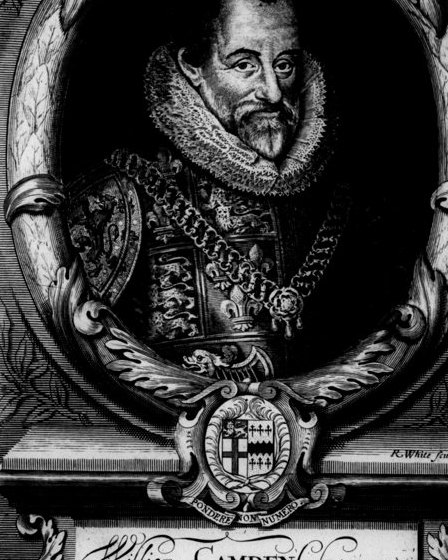
Who they were
Camden was born in the Old Bailey in London on 2 May 1551.
From Dictionary of National Biography, vol. 8, 'Camden, William', by Edward Maunde Thompson: “was born in the Old Bailey in London on 2 May 1551” See the page
His father, Sampson Camden, was a painter.
From Dictionary of National Biography, vol. 8, 'Camden, William', by Edward Maunde Thompson: “came up to London to follow the profession of a painter” See the page
At twelve he caught the plague at Islington.
From Dictionary of National Biography, vol. 8, 'Camden, William', by Edward Maunde Thompson: “In 1563, at the age of twelve, the boy was attacked by the plague at Islington” See the page
In 1575 he became second master at Westminster School.
From Dictionary of National Biography, vol. 8, 'Camden, William', by Edward Maunde Thompson: “he was appointed in 1575 to the second mastership in Westminster School” See the page
In the school holidays he travelled to look at the country's antiquities.
From Dictionary of National Biography, vol. 8, 'Camden, William', by Edward Maunde Thompson: “A schoolmaster's life still left him free in holiday time to make occasional journeys of inquiry.” See the page
He finished Britannia after ten years' work, and dated it 2 May 1586, his thirty-fifth birthday.
From Dictionary of National Biography, vol. 8, 'Camden, William', by Edward Maunde Thompson: “After ten years' toil the ‘Britannia’ was completed, and appeared with a dedication to Lord-treasurer Burghley, dated 2 May 1586, the day on which Camden completed his thirty-fifth year.” See the page
In 1597 he became Clarenceux king of arms.
From Dictionary of National Biography, vol. 8, 'Camden, William', by Edward Maunde Thompson: “the office of Clarenceux king-of-arms fell vacant, and on 23 Oct. Camden was appointed to the place” See the page
He died on 9 November 1623, and lies in Westminster Abbey.
From Dictionary of National Biography, vol. 8, 'Camden, William', by Edward Maunde Thompson: “put an end to his life, 9 Nov. 1623 ... carried to burial in the abbey” See the page
In Craven
In 1582 he made a journey through Suffolk into Yorkshire, and came home by Lancashire.
From Dictionary of National Biography, vol. 8, 'Camden, William', by Edward Maunde Thompson: “He has noted in his biographical ‘Memorabilia’ in 1582 a journey through Suffolk into Yorkshire, returning by way of Lancashire.” See the page
He guessed that Craven took its name from a British word for a rock.
From William Camden, Britannia, ed. Edmund Gibson (London, 1722): “is call'd Craven, possibly from the British word Crage, a rock” See the page
6 quotes on 4 places
A bigger dot means more quotes. Tap a dot to open the place.
What they wrote
-
Where Craven ends, and 1 more
1586 · 1586 (Gibson's English, 1722)
“The Are having pass'd Craven, is carry'd in a much larger chanel with pleasant fields on both sides, by Kigheley”
William Camden, antiquary; his Latin of 1586 in Edmund Gibson's English. See the page
Source and note
William Camden, Britannia, ed. Edmund Gibson (London, 1722), West Riding of Yorkshire.
Camden puts Keighley below Craven. Whitaker's deanery of Craven includes Keighley parish.
-
1722 · 1722 edition
“runs to Barden toure, a little tower ... belonging to the ... Earls of Cumberland, noted ... for the good hunting thereabouts”
William Camden, in Gibson's edition, Elizabethan antiquary. See the page
Source and note
William Camden, Britannia, ed. Edmund Gibson (London, 1722).
The scan runs the margin notes into Camden's sentence, so the cuts mark margin words, not cuts in the sentence. The sentence reads 'the Wherf runs to Barden toure, a little tower belonging to the Earls of Cumberland, noted for the good hunting thereabouts'.
-
1586 · 1586 (Gibson's English, 1722)
“the seat of the famous family of Claphams”
William Camden, Elizabethan antiquary. See the page
Source and note
William Camden, Britannia, Edmund Gibson's English edition (London, 1722).
Camden wrote in Latin in 1586; these are the words of Gibson's English edition.
-
1722 · 1722 English edition of Britannia (first published 1586)
“it shoots out in a vast ridge rising gradually to the westward, and towards the end mounts up as if another hill ... were laid upon the back of it.”
William Camden, antiquary. See the page
Source and note
Britannia, or a Chorographical Description of Great Britain and Ireland, English edition, vol. 2 (London, 1722), page cols. 971-972.
The cut is the word 'Penigent', a side-note that the scan prints inside the sentence.
-
1722 · 1722 English edition of Britannia (first published 1586)
“Penigent, so call'd perhaps from it's white and snowy head ... it is a huge mountain, but not so high as the other.”
William Camden, antiquary. See the page
Source
Britannia, or a Chorographical Description of Great Britain and Ireland, English edition, vol. 2 (London, 1722), page cols. 971-972.