UK · England · North Yorkshire · Craven · In Halton Gill
Pen-y-ghent

What the writers say
Camden says the name may come from its white, snowy head. Howson says William Paley thought it looked like a raised pie. Speight tells a tale of Israel Jobson, a cobbler at Horton, who built a ladder on it and climbed to the moon.
-
1722 · 1722 English edition of Britannia (first published 1586)
“Penigent, so call'd perhaps from it's white and snowy head ... it is a huge mountain, but not so high as the other.”
William Camden, antiquary. See the page
Source
Britannia, or a Chorographical Description of Great Britain and Ireland, English edition, vol. 2 (London, 1722), page cols. 971-972.
-
1773
“The great hill of Penygent is seen from hence, and is about six miles distant.”
Thomas Pennant, Welsh naturalist and travel writer, touring in 1773. See the page
Source and note
Thomas Pennant, A Tour from Downing to Alston-Moor (London: Edward Harding, 1801); the tour was made in 1773, page 112.
Pennant is writing at Settle.
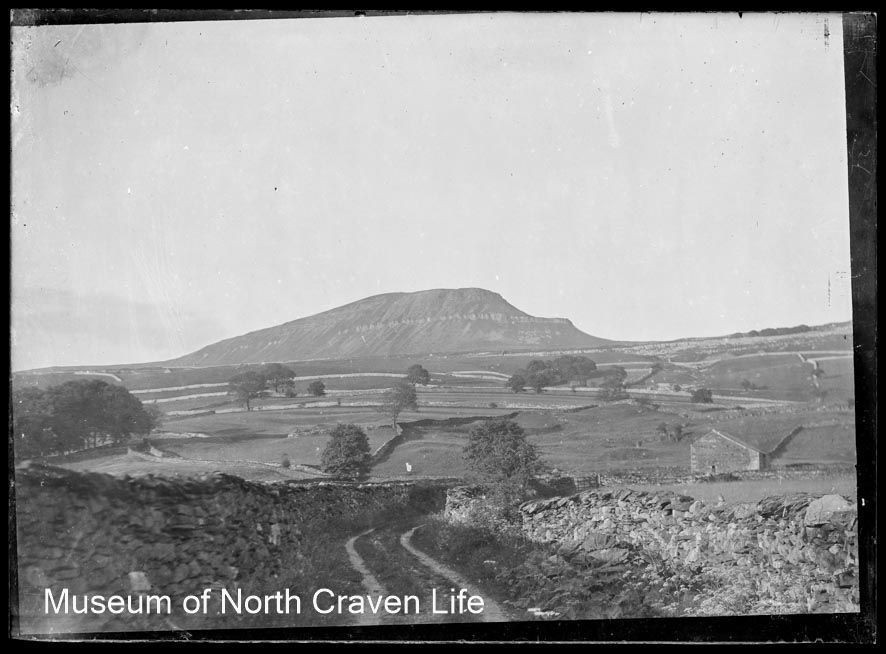
Pen-y-ghent, Horner Photographic Studio, about 1875 to about 1925, Victorian. The Horner Photographic Collection, Museum of North Craven Life (The Folly), Settle. CC BY 4.0. See the work -
1800 · 1800 (this copy printed 1808)
“is a towering and elegant mountain standing pre-eminent among several lesser fells.”
John Housman, guidebook writer. See the page
Source and note
A Descriptive Tour, and Guide to the Lakes, Caves, Mountains, and other Natural Curiosities (Carlisle: F. Jollie, 1808 edition), page 41.
The sentence begins 'Pennygant', which the scan splits in two.
-
1850
“He was observed by a friend gazing intently up the valley from Settle Bridge, and being asked what attracted his attention, "I was thinking," said the Dr., "how like Penyghent is to a raised pie"”
William Howson, guidebook writer. See the page
Source and note
An Illustrated Guide to the Curiosities of Craven (London: Whittaker, 1850), page 52.
A footnote. 'The Dr.' is Archdeacon William Paley.
-
1858
“Penyghent, Pendle. and Ingleborough, Are the highest ... the country thorough, is an ancient proverb of that boastful county”
Settle Chronicle, the monthly Settle paper. See the page
Source and note
The Settle Chronicle and North Ribblesdale Advertiser, 1858 volume. Scans held by the Museum of North Craven Life, published by the North Craven Building Preservation Trust (CC BY-NC-SA 4.0), page 27.
The scan reads 'bills' for 'hills', so we cut that word.
-
1892
“he made and erected on Penyghent, an immense ladder that enabled him, after a long and fatiguing journey, to reach the moon.”
Harry Speight, Craven historian and walker. See the page
Source and note
The Craven and North-West Yorkshire Highlands (London: Elliot Stock, 1892), page 397.
'He' is Israel Jobson, a cobbler of Horton. Speight says the story comes from a tract, The Man in the Moon, by the Rev. Miles Wilson.
-
1892
“Six years ago over sixty sheep perished at once in a tremendous snow-drift here, above Thund Pot”
Harry Speight, Craven historian and walker. See the page
Source
The Craven and North-West Yorkshire Highlands (London: Elliot Stock, 1892), page 394.