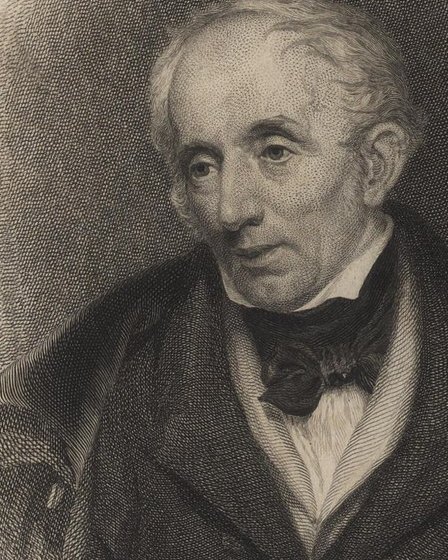
Who they were
Wordsworth was born at Cockermouth in Cumberland on 7 April 1770.
From Dictionary of National Biography, vol. 63, 'Wordsworth, William', by Leslie Stephen: “was born at Cockermouth, Cumberland, on 7 April 1770” See the page
His mother died in March 1778, when he was seven.
From Dictionary of National Biography, vol. 63, 'Wordsworth, William', by Leslie Stephen: “The mother died ‘of a decline’ in March 1778.” See the page
That year he went to the grammar school at Hawkshead, and lodged with Anne Tyson.
From Dictionary of National Biography, vol. 63, 'Wordsworth, William', by Leslie Stephen: “In 1778 Wordsworth and his elder brother were sent to the grammar school at Hawkshead ... Wordsworth lived in the cottage of Anne Tyson” See the page
In 1790 he and his friend Robert Jones toured on foot, with their things in pocket-handkerchiefs.
From Dictionary of National Biography, vol. 63, 'Wordsworth, William', by Leslie Stephen: “They took 20 l . apiece, carried all they required in pocket-handkerchiefs, and made their tour on foot.” See the page
He and Coleridge brought out Lyrical Ballads in September 1798, and Wordsworth wrote most of it.
From Dictionary of National Biography, vol. 63, 'Wordsworth, William', by Leslie Stephen: “The result was the publication of the ‘Lyrical Ballads,’ ... The book appeared in September, Wordsworth contributing the largest part of the contents.” See the page
He and his sister Dorothy walked to Dove Cottage at Grasmere, and arrived on 21 December 1799.
From Dictionary of National Biography, vol. 63, 'Wordsworth, William', by Leslie Stephen: “travelled on foot with his sister from Sockburn, reaching Dove Cottage on 21 Dec. 1799” See the page
Early in 1813 he moved to Rydal Mount, his home for the rest of his life.
From Dictionary of National Biography, vol. 63, 'Wordsworth, William', by Leslie Stephen: “Early in 1813 he moved accordingly to Rydal Mount, the house which he occupied for the rest of his life.” See the page
Lord Lonsdale got him the post of distributor of stamps for Westmorland.
From Dictionary of National Biography, vol. 63, 'Wordsworth, William', by Leslie Stephen: “Lonsdale obtained for him the office of distributor of stamps for the county of Westmoreland” See the page
When Southey died in 1843, the government offered Wordsworth the post of poet laureate.
From Dictionary of National Biography, vol. 63, 'Wordsworth, William', by Leslie Stephen: “Upon the death of Southey (21 March 1843) the poet-laureateship was offered to Wordsworth” See the page
He died on 23 April 1850, and lies in Grasmere churchyard.
From Dictionary of National Biography, vol. 63, 'Wordsworth, William', by Leslie Stephen: “dying peacefully on 23 April 1850. He was buried in Grasmere churchyard” See the page
In Craven
He first saw Bolton Priory in the summer of 1807.
From William Wordsworth, The White Doe of Rylstone; or, The Fate of the Nortons (London: Longman, 1815), Advertisement: “During the summer of 1807, the Author visited, for the first time, the beautiful Scenery that surrounds Bolton Priory, in Yorkshire” See the page
He wrote The White Doe of Rylstone in 1807 and 1808, and published it in 1815.
From Dictionary of National Biography, vol. 63, 'Wordsworth, William', by Leslie Stephen: “The ‘White Doe of Rylstone’ (published in 1815) had been written in 1807−8” See the page
The same book held The Force of Prayer, his poem on the founding of Bolton Priory.
From Dictionary of National Biography, vol. 63, 'Wordsworth, William', by Leslie Stephen: “‘includes the Force of Prayer; or the Founding of Bolton Abbey.’” See the page
His sonnet on Gordale came out with Peter Bell in 1819.
From William Wordsworth, Peter Bell, a Tale in Verse (London, 1819), sonnet 'Gordale'; Wikisource transcription: “Then, pensive votary, let thy feet repair To Gordale-chasm, terrific as the lair” See the page
5 quotes on 4 places
A bigger dot means more quotes. Tap a dot to open the place.
What they wrote
-
Bolton Priory, and 1 more
1815
“During the summer of 1807, the Author visited, for the first time, the beautiful Scenery that surrounds Bolton Priory, in Yorkshire”
William Wordsworth, poet. See the page
Source
William Wordsworth, The White Doe of Rylstone; or, The Fate of the Nortons (London: Longman, 1815), Advertisement.
-
1819
“Then, pensive votary, let thy feet repair To Gordale-chasm, terrific as the lair”
William Wordsworth, poet. See the page
Source and note
William Wordsworth, Peter Bell, a Tale in Verse (London, 1819), sonnet 'Gordale'; Wikisource transcription.
Howson (1850, p. 43) says Wordsworth did not write his sonnets on the Cove and Gordale on the spot. Westall's engravings gave him the idea.
-
1815
“From Rylstone she hath found her way Over the hills this sabbath-day”
William Wordsworth, poet. See the page
Source and note
William Wordsworth, The White Doe of Rylstone (London: Longman, 1815), page 13.
In the poem a white doe walks every Sunday from Rylstone to Bolton Priory. Howson (1850) calls this a tradition.
-
1815
“This Striding-place is called The Strid, A name which it took of yore: A thousand years hath it borne that name, And shall, a thousand more.”
William Wordsworth, poet. See the page
Source and note
William Wordsworth, 'The Force of Prayer; or, The Founding of Bolton Priory', Poems, vol. II (London, 1815).
Wikisource transcription of the 1815 edition, with its page scans.