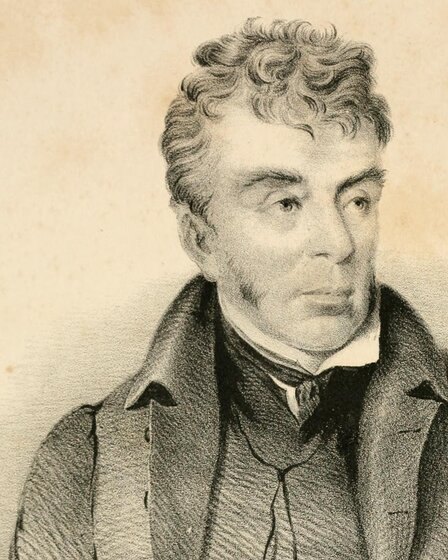
In their own words
“For the first time I now attempt to play, Fretting, with skilless touch, the sonnet’s wire.”
The New Monthly Magazine, vol. 48, October 1836, 'The Corn-Law Rhymer's Pilgrimage'. See the page
Who they were
Elliott was born at Masbrough, near Rotherham, on 17 March 1781.
From Dictionary of National Biography, vol. 17, 'Elliott, Ebenezer', by Francis Watt: “was born at the New Foundry, Masborough, parish of Rotherham, Yorkshire, 17 March 1781” See the page
People called his father Devil Elliott, and he worked in the iron trade.
From Dictionary of National Biography, vol. 17, 'Elliott, Ebenezer', by Francis Watt: “His father, known as 'Devil Elliott,' was engaged in the iron trade” See the page
Smallpox at five left him scarred and blind for six weeks.
From Dictionary of National Biography, vol. 17, 'Elliott, Ebenezer', by Francis Watt: “In his sixth year he had the small-pox, which left him 'fear-fully disfigured and six weeks blind.'” See the page
He said his love of nature made him desert both alehouse and chapel.
From Dictionary of National Biography, vol. 17, 'Elliott, Ebenezer', by Francis Watt: “His love of nature, he says, caused him 'to desert both alehouse and chapel.'” See the page
His father's firm failed, and Elliott lost every penny he had.
From Dictionary of National Biography, vol. 17, 'Elliott, Ebenezer', by Francis Watt: “he lost every penny he had in the world” See the page
In 1821 his wife's family raised a little money, and he started in the iron trade in Sheffield.
From Dictionary of National Biography, vol. 17, 'Elliott, Ebenezer', by Francis Watt: “In 1821 his wife's relatives raised a little money, and with this as capital he started in business in the iron trade in Sheffield.” See the page
He blamed the corn laws for his losses, and attacked them in his Corn-law Rhymes of 1831.
From Dictionary of National Biography, vol. 17, 'Elliott, Ebenezer', by Francis Watt: “he attributed to the operation of the corn laws ... It was this state of mind that produced the 'Corn-law Rhymes' (1831)” See the page
He was a small, meek-looking man.
From Dictionary of National Biography, vol. 17, 'Elliott, Ebenezer', by Francis Watt: “Elliott was a small, meek-looking man.” See the page
He died at Great Houghton on 1 December 1849, after the bread tax he hated had gone.
From Dictionary of National Biography, vol. 17, 'Elliott, Ebenezer', by Francis Watt: “He died there, having lived to see the hated 'bread tax' abolished, on 1 Dec. 1849” See the page
In Craven
In October 1836 the New Monthly Magazine printed his sonnets, The Corn-Law Rhymer's Pilgrimage.
From The New Monthly Magazine, vol. 48, October 1836, 'The Corn-Law Rhymer's Pilgrimage', page 150: “THE CORN-LAW RHYMER’S PILGRIMAGE” See the page
One sonnet takes him to Bolton Abbey, by the Wharfe and Barden Tower.
From The New Monthly Magazine, vol. 48, October 1836, 'The Corn-Law Rhymer's Pilgrimage', page 151: “By strangled Wharfe, or Barden’s ancient tower” See the page
In a note he told of a young woman from London who drowned in the Strid about three years before.
From The New Monthly Magazine, vol. 48, October 1836, 'The Corn-Law Rhymer's Pilgrimage', page 151: “About three years ago, a young lady came from London on a visit to a relative” See the page
2 quotes on 2 places
A bigger dot means more quotes. Tap a dot to open the place.
What they wrote
-
1836 · October 1836
“Spirits of wonder, loveliness, and fear, Dwell in these groves, beneath o'er-arching trees”
Ebenezer Elliott, the Corn-Law Rhymer, Sheffield poet, in a sonnet on Bolton Abbey. See the page
Source and note
The New Monthly Magazine, vol. 48, October 1836, 'The Corn-Law Rhymer's Pilgrimage', page 151.
The magazine prints the series under the name the Corn-Law Rhymer, which was Ebenezer Elliott's.
-
1836 · October 1836
“she had taken the fatal plunge ! gentleman, a few yards below, seized her bonnet ; but the strings broke, and she was drowned !”
Ebenezer Elliott, the Corn-Law Rhymer, Sheffield poet, in a note to his sonnet on Bolton Abbey. See the page
Source and note
The New Monthly Magazine, vol. 48, October 1836, 'The Corn-Law Rhymer's Pilgrimage', page 151.
Elliott says this happened 'about three years ago', which would be about 1833. Howson and the Lancaster Gazette give 1828 for a young woman who drowned here. The scan has lost the 'A' before 'gentleman'.