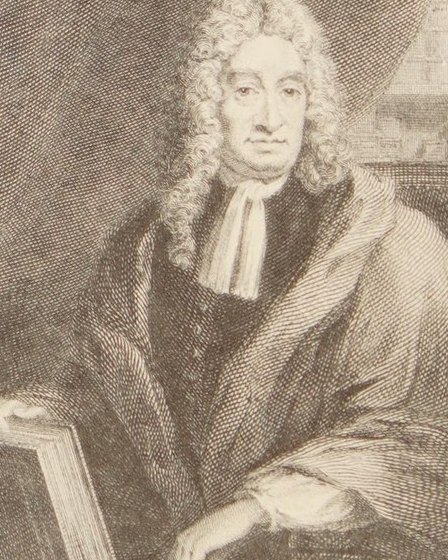
Daniel Defoe
Journalist and novelist, author of Robinson Crusoe and A Tour through Great Britain
Defoe died in 1731. Later editors revised his Tour and kept it in print. The words on Craven and Settle that we quote come from their 1779 edition. We did not find them in Defoe's own text, in a reprint of 1928.
In their own words
“Indeed, they were, in my thoughts, monstrous high”
Daniel Defoe, A Tour through England and Wales, vol. II (London: J. M. Dent, Everyman's Library, 1928), a reprint of Defoe's own text of 1724 to 1726. See the page
Who they were
Defoe was born in 1660 or 1661 in the parish of St Giles, Cripplegate, in London.
From Dictionary of National Biography, vol. 14, 'Defoe, Daniel', by Leslie Stephen: “was born in 1660 or 1661 in the parish of St. Giles's, Cripplegate” See the page
His father, James Foe, was a butcher.
From Dictionary of National Biography, vol. 14, 'Defoe, Daniel', by Leslie Stephen: “His father, James Foe, was a younger son, who became a butcher in St. Giles's” See the page
About 1703 he changed his name from Foe to De Foe.
From Dictionary of National Biography, vol. 14, 'Defoe, Daniel', by Leslie Stephen: “Foe changed his name to De Foe or Defoe about 1703” See the page
In 1688 he joined William of Orange's army at Henley.
From Dictionary of National Biography, vol. 14, 'Defoe, Daniel', by Leslie Stephen: “In 1688 he joined William's army at Henley” See the page
In July 1703 he stood three days in the pillory, and the crowd covered it with flowers.
From Dictionary of National Biography, vol. 14, 'Defoe, Daniel', by Leslie Stephen: “Defoe stood in the pillory on 29, 30, and 31 July 1703. The people formed a guard, covered the pillory with flowers, and drank his health.” See the page
He then sat in Newgate prison until August 1704.
From Dictionary of National Biography, vol. 14, 'Defoe, Daniel', by Leslie Stephen: “Defoe was now imprisoned in Newgate ... in August 1704, he was released from prison” See the page
On 25 April 1719 he published the first volume of Robinson Crusoe.
From Dictionary of National Biography, vol. 14, 'Defoe, Daniel', by Leslie Stephen: “On 25 April 1719 he published the first volume of ‘Robinson Crusoe,’” See the page
His Tour through Great Britain came out in three volumes from 1724 to 1726.
From Dictionary of National Biography, vol. 14, 'Defoe, Daniel', by Leslie Stephen: “the ‘Tour through Great Britain,’ of which three volumes appeared in 1724–5–6” See the page
He died in Ropemakers' Alley, Moorfields, on 26 April 1731.
From Dictionary of National Biography, vol. 14, 'Defoe, Daniel', by Leslie Stephen: “died ‘of a lethargy,’ in Ropemakers' Alley, Moorfields (not then a miserable quarter), on 26 April 1731” See the page
In Craven
Defoe wrote that the Aire rises at the foot of Penyghent and runs by Skipton.
From Daniel Defoe, A Tour through England and Wales, vol. II (London: J. M. Dent, Everyman's Library, 1928), a reprint of Defoe's own text of 1724 to 1726: “more particularly at the foot of the mountain Pennigent ... so the Aire runs by Skippon, Bradforth and thorough Leeds” See the page
He quoted the old rhyme that Ingleborough, Pendle and Penyghent are the highest hills between Scotland and Trent.
From Daniel Defoe, A Tour through England and Wales, vol. II (London: J. M. Dent, Everyman's Library, 1928), a reprint of Defoe's own text of 1724 to 1726: “Inglebrough, Pendle-hill and Penigent, Are the highest hills between Scotland and Trent.” See the page
Later editors of his Tour said they brought it down to their own time.
From A Tour thro' the Whole Island of Great Britain, vol. 3, ninth edition (London, 1779), 'originally begun' by Defoe and continued by later editors: “brought down to the preſent Time by Gentlemen of Eminence in the Literary World” See the page
The 1779 edition takes the reader into Craven and on to Settle.
From A Tour thro' the Whole Island of Great Britain, vol. 3, ninth edition (London, 1779), 'originally begun' by Defoe and continued by later editors: “We soon entered Craven, which is a very hilly” See the page
The journey
Over Blackstone Edge and north up the west side of Yorkshire. The middle of August, in a year Defoe does not give. His third volume came out in 1726..
None of the 18 stops is inside Craven. Light dots are stops inside Craven. Each stop is a place the writer names, and their words are listed under the maps. Straight lines join the stops. We do not know every road they took.
How we know each stop: all 18, in the writer's own words
1. Liverpool
“I follow'd this post-road, from Liverpool to Bury and Rochdale”, page 596. See the page
Defoe says he made three journeys through this country. On this one he came out of Cheshire and Lancashire.
2. Bury
“I follow'd this post-road, from Liverpool to Bury and Rochdale”, page 596. See the page
3. Rochdale · the middle of August
“the sun shone when we came out of the town of Rochdale”, page 597. See the page
Defoe says it was the middle of August, and the hills were already white with snow. He gives no year.
4. Blackstone Edge · the middle of August
“the main hill which we came down from, which is properly called Blackstone Edge”, page 598. See the page
Defoe crossed the Pennines here in a snowstorm.
5. Sowerby Bridge · the middle of August
“at the next village we pass'd it over a stately stone bridge of several great arches. This village is called Sorby or Sowreby”, page 603. See the page
Defoe spells it Sorby or Sowreby. The river he crossed is the Calder.
6. Halifax
“We quitted Hallifax not without some astonishment at its situation”, page 610. See the page
Defoe spells it Hallifax.
7. Leeds
“As I made this little excursion to see the town of Pontefract from Leeds”, page 617. See the page
Defoe writes that the Aire rises at the foot of Pennigent and runs by Skipton. He does not say he went up Airedale into Craven.
8. Pontefract
“I took a little trip to see the antient town of Pontefract”, page 615. See the page
A side trip from Leeds.
9. Leeds
“you must suppose me now returned thither, and setting out thence northward”, page 617. See the page
10. Harewood Bridge
“pass'd the Wharfe, at a fine stone bridge of eleven arches at a little pretty town call'd Harwood”, page 617. See the page
Defoe spells it Harwood.
11. Ripley
“From the Wharfe we went directly north, over a continued waste of black, ill looking, desolate moors”, page 618. See the page
The passage goes on: to a town call'd Ripley.
12. Knaresborough
“when my landlord at Knaresborough took me short”, page 619. See the page
13. Ripon
“But I must not leave Rippon without giving the fam'd tale of St. Wilfrid's Needle”, page 623. See the page
Defoe spells it Rippon.
14. Boroughbridge
“Burrow Bridge, which is but three miles below Rippon, upon the same River Eure, and which I must take in my way”, page 627. See the page
Defoe spells it Burrow Bridge.
15. Bedale
“I met with nothing at or about Bedall, that comes within the compass of my enquiry but this”, page 628. See the page
Defoe spells it Bedall.
16. Richmond
“Leaving Richmond, we continue through this long Leeming Lane”, page 630. See the page
17. Piercebridge
“we pass'd over the River Tees at Piersbridge”, page 630. See the page
Defoe spells it Piersbridge. The Tees was the edge of Yorkshire.
18. Barnard Castle
“Barnard's Castle stands on the north side of the Tees ... here we saw some very fine horses indeed”, page 631. See the page
Defoe ends his eighth letter here, at the north edge of Yorkshire.
From Daniel Defoe, A Tour thro' the Whole Island of Great Britain, vol. 3 (London, 1726), Letter 8, in Defoe's own first-edition text. Quoted from the transcription on A Vision of Britain through Time; pages and links are to the 1927 reprint of the first edition (vol. 2), on archive.org..
2 quotes on 1 place
A bigger dot means more quotes. Tap a dot to open the place.
What they wrote
-
1779
“Here the road turns north-west, which brought us to a place called Settle, a much better town than we expected in such a country.”
A Tour through the Island of Great Britain, the guide Daniel Defoe began in 1724, here in an edition that later editors continued. See the page
Source and note
A Tour through the Island of Great Britain, vol. 3 (1779 edition); 'originally begun by the celebrated Daniel De Foe, continued by the late Mr. Richardson'.
The words are the 1779 editors', not necessarily Defoe's own. We typed the long s as s. The link opens a search inside the scan, since its two columns are run together.
-
1779
“We soon entered Craven, which is a very hilly ... and craggy country, as the name signifies”
Defoe's Tour, 1779 edition, the editors who revised Defoe's Tour. See the page
Source and note
Daniel Defoe and later editors, A Tour thro' the Whole Island of Great Britain, 8th edition, vol. 3 (London, 1778 to 1779).
The scan runs two columns together, so the cut marks words from the next column. These are the editors' words, not Defoe's own.